Modena Cathedral & the Ghirlandina: A Guide to the UNESCO Site
FNFrancesco NoliThe short answer
Modena Cathedral, the Ghirlandina tower and Piazza Grande form a Romanesque complex that has been a UNESCO World Heritage Site since 1997. The cathedral was begun in 1099 by the architect Lanfranco and carved by the sculptor Wiligelmo; the Porta della Pescheria holds the first carved King Arthur cycle in Italy, and the Ghirlandina tower (about 89 metres) keeps the famous Stolen Bucket. With the Cathedral Museums and the Estense city around it, it's all in the walkable historic centre.
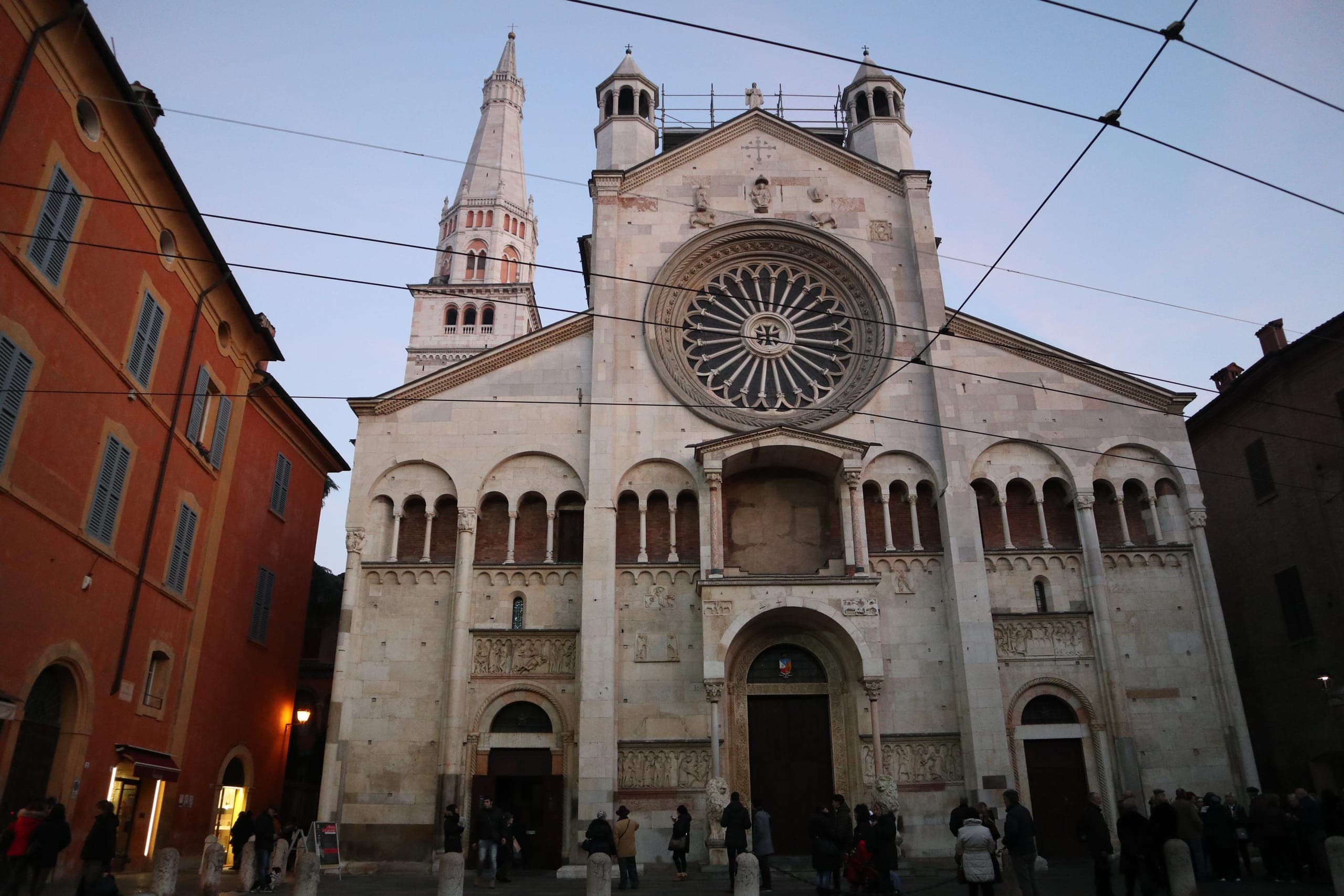
A complete guide to Modena Cathedral (Duomo), the Ghirlandina tower and Piazza Grande: history, the King Arthur carvings, the mysterious Metopes, the Stolen Bucket, what to see inside, the museums and how to visit the UNESCO site.
In the heart of Modena, along the ancient Via Emilia, stands one of the most important Romanesque ensembles in Europe: the Cathedral (Duomo), the Ghirlandina tower and Piazza Grande, together a UNESCO World Heritage Site since 1997. It isn't just beautiful to look at — it's a book written in stone, telling a thousand years of history, art and Modenese identity. This guide takes you through every detail, from Wiligelmo's carved Genesis to the mysterious Metopes, from the King Arthur cycle to the Stolen Bucket, and explains how to visit, what's inside, and the museums that complete the story.
We live and host here, a few minutes from the Duomo, and we've walked visitors round this square more times than we can count. What follows is the guide we wish we'd had: the full backstory, the small details most people miss, and the practical notes — opening hours, climbing the tower, where to park, when to come — that turn a quick photo stop into a proper visit. Read it before you arrive and the stones will start to speak.
How to get to Modena, and finding the Cathedral
For visitors coming from abroad, Modena is far easier to reach than its size suggests. It sits squarely on the Via Emilia and the A1 motorway, the great corridor that runs across northern Italy, and on the main Bologna–Milan railway line. From Bologna, the natural gateway, regional trains reach Modena in roughly 30 minutes (the fastest in about 17), with more than a hundred departures a day from as little as a few euros; the line continues from Florence in about 1h05, Milan in about an hour, and Rome in around 2h30 with a change. The nearest airport is Bologna Marconi (BLQ): from there you can take the Marconi Express monorail to Bologna Centrale and a train on to Modena (about 54 minutes all told), a direct bus (around 45 minutes), or a taxi/car (about 33 minutes, roughly 41 km).
Once in Modena, everything you'll read about here is on foot. The station is about a 10-minute walk from Piazza Grande, straight down Corso Vittorio Emanuele II into the centre. If you arrive by car, remember that the historic centre is a ZTL — a camera-enforced limited-traffic zone — so leave the car in one of the car parks just outside the ring of avenues (the Viali) and walk in. Many travellers treat Modena as a relaxed day from Bologna or as a base in its own right; either way, the Duomo, Ghirlandina and Piazza Grande are the obvious first stop, all within the same single square. If you're basing yourself in Bologna, see our dedicated guide to a Modena day trip from Bologna.
Piazza Grande, Modena's living room
It all begins in Piazza Grande, founded in the second half of the 12th century along the Via Emilia and the civic and religious heart of the city for almost a thousand years. This is where Modena has always gathered: markets, proclamations, festivals, and the patron saint's procession every January. The square is part of the UNESCO inscription precisely because it isn't a museum set-piece but a living public space, designed from the start as the meeting point of religious power (the Cathedral) and civic power (the town hall) along the great Roman road.
On the side of the Palazzo Comunale (the town hall, also part of the UNESCO site), look for the Preda Ringadora, the long rectangular stone from which medieval officials made public addresses and proclamations — the word comes from arringare, to harangue. Beside it stood the place where bankrupt debtors were once publicly shamed. At the corner of the building, set into a niche, is the medieval statue of the Bonissima, a small, enigmatic female figure that has watched over the square for centuries; nobody is entirely sure who she represents — perhaps a symbol of honest weights and measures in the medieval market, perhaps a benefactress — and that mystery is part of her charm.
The Palazzo Comunale rewards a closer look inside, too (access depends on opening hours and civic events). Upstairs, the Sala del Fuoco — the Hall of Fire — is frescoed by Niccolò dell'Abate in 1546, one of the great Mannerist painters of the Emilian school, who later worked at Fontainebleau for the kings of France. And in the attic of the town hall sits one of the most Modenese things imaginable: the Acetaia Comunale, the city's own loft of barrels where genuine Aceto Balsamico Tradizionale quietly ages, batteries of casks resting under the roof tiles. It is visitable on set days, and it ties the monumental square straight to the flavour of the place — to learn more about that, see our guide to balsamic vinegar, Modena's black gold. Come to the square early, while it's empty and the light is low: it's the loveliest moment of the day, and the best for photographs of the façade and the tower together.
The Cathedral: a Romanesque masterpiece
Modena Cathedral was begun in 1099 by the architect Lanfranco, on the site of an earlier early-Christian basilica, to house the remains of Saint Geminiano, the city's patron. The foundation stone was laid on 9 June 1099, and the project was so important to the people of Modena that the chronicles record the whole community taking part — bringing materials, money and labour — at a time when Modena had no bishop in residence to drive the work. That popular, civic origin is unusual, and it explains why the Duomo has always felt as much the city's building as the Church's.
It is one of the purest and most powerful examples of European Romanesque: solid lines, pale stone — some of it recycled Roman material quarried from the ruins of the ancient Mutina and reused in the walls and crypt — and a balance that still takes your breath away. The exterior is wrapped in a continuous rhythm of small blind arches and a gallery of slender columns (the loggette) running below the roofline, a hallmark of the style that gives the heavy stone a surprising lightness. The remains of Saint Geminiano were solemnly translated into the new crypt in 1106, with the aged Countess Matilda of Canossa present and, tradition holds, Pope Paschal II — a sign of how far the cathedral's prestige already reached.
Part of its greatness is that, for its time, it was something new: for the first time an architect and a sculptor signed the work together, with explicit inscriptions still legible on the building. The dedicatory inscription on the façade praises Lanfranco as a "wonderful builder", and Wiligelmo is named in a stone tablet that asks "how worthy you are of honour among sculptors". That collaboration between Lanfranco and Wiligelmo is, in UNESCO's words, "a masterpiece of human creative genius, in which a new dialectical relationship between architecture and sculpture is imposed." It is exactly this — the documented, signed partnership of architect and sculptor, and the building's authenticity as a working cathedral still at the centre of city life — that earned the inscription on the World Heritage List in 1997, under the criteria for a masterpiece of human creative genius and an outstanding testimony to a cultural tradition.
The façade and Wiligelmo
On the façade, the sculptor Wiligelmo left his masterpiece: the four panels of the Stories of Genesis, set in a long horizontal frieze across the front, running from the creation of Adam and Eve to the murder of Abel and the Flood, ending with Noah's ark. They are among the most important works of medieval sculpture in Italy — and, in many accounts, the work that marks the rebirth of monumental figurative sculpture in Europe after the long quiet of the early Middle Ages. The figures are intense, living and deeply human: Adam newly woken into being, Eve drawn from his side, the heavy grief of the expulsion from Eden. Wiligelmo carves volume and emotion back into stone, and you can feel the artist rediscovering what marble can do.
Above the frieze, the great rose window was opened later (in the Gothic period) and reworked by the Campionese masters; it filters a soft wheel of light into the nave. The main portal below is framed by a deep splayed arch and guarded by two stylophore lions — lions bearing columns on their backs, some of them genuinely ancient Roman pieces reused here — with prophets and the Labours flanking the jambs. Stop and read the reliefs the way 12th-century worshippers did: most could not read a word of Latin, so the Bible was carved for them in stone, scene by scene. This was their illustrated Bible, and it still works.
The Porta della Pescheria and the King Arthur cycle
This is the cathedral's best-kept secret. On the north side, in the fourth arch from the east, opens the Porta della Pescheria ("Fish Market Door"), the work of a master distinct from Wiligelmo, in a Burgundian style. Carved into the archivolt is an extraordinary scene: knights with lances storming a castle where a woman is held prisoner, hands clasped in supplication. It is the King Arthur cycle — the first carved Arthurian representation in Italy, and one of the oldest in Europe, predating many of the literary texts on the subject.
On the door jambs runs the cycle of the twelve months and the labours of the year: the pruning of vines in spring, the harvest, the grape-picking and pressing in autumn, the killing of the pig and the warming by the fire in winter — medieval Emilian peasant life fixed in stone, a calendar you can read with your hands. These reliefs alone are worth the trip, and it's a reminder that this land has been about working the soil, the vine and the table for a thousand years.
The other portals
The Pescheria is the most famous, but the cathedral has three main doorways, each worth a moment. The Porta dei Principi ("Door of the Princes"), on the south side facing Piazza Grande, is from Wiligelmo's own workshop and carries scenes from the life of Saint Geminiano himself — the right door to look at if you want to follow the patron's story. The Porta Regia ("Royal Door"), also on the south side, is the grand ceremonial entrance from the square, a later Gothic addition by the Campionese masters with a richly carved porch resting on two red marble lions; this is the door the bishop and the city's processions traditionally used. Together with the main west portal on the façade, these doorways turn the whole exterior of the Duomo into a single carved narrative — there is no "back" of this building, every side has something to read.
The Metopes: Modena's mysterious sculptures
Look up at the building and you'll see strange figures perched high on the heads of the nave arches: the famous Metopes. In classical architecture a "metope" is the square panel between the triglyphs of a temple frieze, and the name was borrowed for these eight stone slabs that originally sat at the tops of the lateral walls, where the arches of the nave meet the roof. They are some of the most mysterious sculptures in all of Italian Romanesque art.
These eight large Romanesque sculptures depict fantastic and monstrous beings — a two-headed figure, a hermaphrodite, people with their feet bound or their bodies contorted, hybrid creatures, beings from the very edges of the medieval imagination. They are not biblical scenes and they are not saints; they sit apart from the ordered, legible carvings of the façade, and that is exactly what makes them so striking. They were carved by an anonymous artist known as the Master of the Metopes, a sculptor of real power working in the generation after Wiligelmo and clearly trained in his orbit, but with a wilder, more disturbing imagination of his own.
Their meaning is still debated by scholars, and no single reading has won. The most common interpretation is that they represent the limits of the known world — the monstrous races believed to live at the rim of the earth, the antipodes and strange peoples of medieval geography — placed high on the building as a frontier between the ordered Christian cosmos below and the unknown beyond. Others read them as moral allegories, images of sin, deformity and the soul gone astray, or as a meditation on the marvels and monstrosity of creation. Whatever they meant to the people who carved them, they remain genuinely uncanny: eight faces looking out from the top of the cathedral that no amount of explanation quite tames.
To protect them from weather and pollution, the originals were taken down and are now safely kept in the Cathedral's Lapidary Museum (one of the Musei del Duomo), where you can stand close to them and feel their strangeness at eye level; faithful copies stand in their place on the building so the skyline keeps its profile. If you only have time for one thing in the Cathedral Museums, make it the Metopes — they are one of the most haunting and original things in the whole UNESCO complex, and very few visitors know to look for them.
Saint Geminiano, the patron who hid the city in fog
Everything here orbits one figure: Saint Geminiano (San Geminiano), the reason the cathedral was built where it stands. Geminiano was Modena's bishop in the fourth century, said to have led the church here for some forty years and to have died on 31 January 397. He was venerated as a wise and holy pastor, and over the centuries a great legend grew around him. The most beloved tale tells that in 451, during the age of barbarian invasions, when Attila and the Huns swept across northern Italy, Saint Geminiano saved Modena by wrapping the city in a thick blanket of fog, so that the invaders passed by without ever finding it. To this day Modenese tell the story with affection — and on a foggy winter morning in the Po Valley, you understand exactly where it came from.
His remains rest in the crypt beneath the high altar, and the cathedral exists, in a real sense, to shelter and honour them. His feast day, the Festa di San Geminiano, falls on 31 January and is the city's biggest civic-religious celebration of the year. On that morning the saint's relics are displayed in the Duomo; the city's civil and military authorities process from the Palazzo Comunale to the Cathedral, traditionally around 10:30, carrying votive candles and the oil that keeps a lamp burning perpetually before the saint's tomb in the crypt. Outside, the whole historic centre fills with a great market and fair, with stalls from early morning right through the day — a tradition that goes back centuries and turns the coldest part of the Modenese winter into a feast. If you can plan your visit around the 31st of January, you'll see the Duomo not as a monument but as a living heart of the city.
Inside the Cathedral
The interior is a classic three-nave basilica, without a projecting transept, its presbytery raised over the crypt on the Cluny model. The first impression is of warmth and verticality: tall compound piers alternate with slender columns, carrying the eye down the nave to the raised choir, while the bare stone and small windows keep the light soft and golden. After the busy carving outside, the interior feels calm and contemplative. Don't miss:
- The rood screen (pontile), the raised, carved parapet that separates the nave from the presbytery and forms a kind of stone stage above the entrance to the crypt. Its front is carved with reliefs of the Passion of Christ — the Last Supper, the betrayal, the road to Calvary — supported by a row of columns resting on crouching telamons and lions. It is a masterpiece of the Campionese masters, a dynasty of sculptor-architects from the Lake Como region who worked at the cathedral from the late 12th century; among them Anselmo da Campione, whose work here (from around 1190) shows the new, more naturalistic French Gothic influence arriving in Modena. Pause here: the pontile is one of the finest pieces of medieval sculpture in the building, and most visitors walk straight past it.
- The ambo (pulpit) resting on the rood screen, carved with the symbols of the four Evangelists, from which the Gospel was read out over the heads of the congregation.
- The crypt beneath the presbytery, a low forest of dozens of slender columns with delicately carved capitals, where the remains of Saint Geminiano rest beneath the altar, enriched with silver lamps and candelabra — the oldest, most sacred and most intimate corner of the cathedral, and the literal reason it was built. Here too is the celebrated terracotta group of the Holy Family (the Madonna della Pappa), a tender, almost domestic scene modelled by the great Modenese Renaissance sculptor Antonio Begarelli, whose warm, life-sized terracotta figures appear throughout the cathedral and give the cool Romanesque interior an unexpected human softness.
- The raised presbytery itself, lifted on the Cluniac model so that the high altar stands above the crypt and the saint's tomb — a piece of stagecraft in stone that lets the relics sit symbolically at the heart of the whole church.
- The play of light through the rose window and the small Romanesque windows, and the warm, spare stone that invites you to slow down and simply sit for a while.
The Ghirlandina
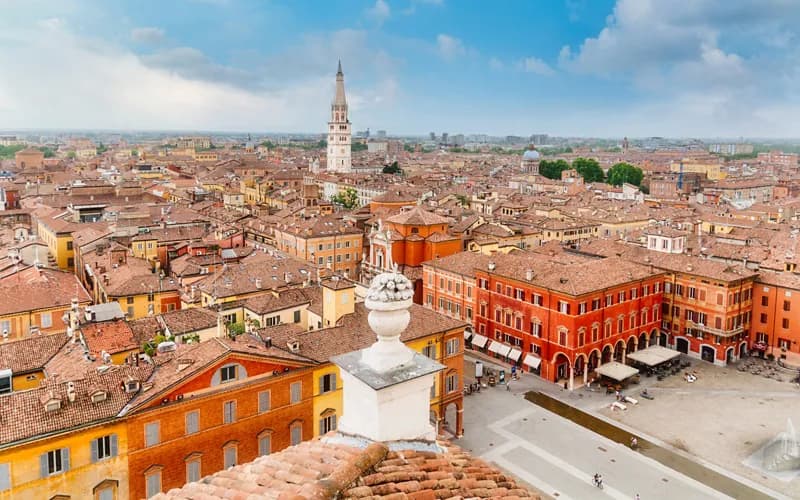
Beside the cathedral rises the Ghirlandina, about 89 metres (89.32 m) tall, the undisputed symbol of Modena and a landmark you can pick out from far across the Po Valley plain. It served the double role of civic tower — the watchtower and pride of the medieval commune — and bell tower of the cathedral, the two powers of the city literally sharing one steeple. Its name, Ghirlandina, perhaps comes from the two delicate garland-like marble balconies (ghirlande) that encircle the base of the spire, lacing the top of the tower like a crown. For centuries it has been the point everything in Modena is measured against, and the slight lean you might notice is real — like several medieval towers, it tilts a little, which has been carefully monitored and consolidated.
The tower was built in stages. The lower, square orders in pale stone date to the era of Lanfranco and Wiligelmo, rising alongside the cathedral itself; the elegant octagonal top and the spire were completed by 1319 by Arrigo da Campione, one of the Campionese masters, giving the Ghirlandina its final, unmistakable silhouette. Climbing up the narrow internal stairs, on the fifth floor you reach the Sala dei Torresani (the Hall of the Tower-Keepers), a beautiful room with eight columns and carved Romanesque capitals where the torresani, the men charged with guarding the tower and sounding the bells in time of fire or danger, once lived and kept watch over the city.
But the most curious treasure connected to the tower is the Secchia Rapita (the "Stolen Bucket"), a humble 14th-century wooden bucket — a copy is shown in the tower, the original is kept safe in the Palazzo Comunale. It's no ordinary object. It recalls the bitter medieval rivalry between Modena and Bologna and the Battle of Zappolino in 1325, a clash between the two cities in which the Modenese won the field and, the story goes, carried off a wooden bucket from a Bolognese well as a trophy of victory and a calculated insult. The legend inspired Alessandro Tassoni's great mock-heroic poem La Secchia Rapita (1622) — a comic epic that treats the theft of a bucket with all the grandeur of Homer, and a founding text of the genre. It's a wonderfully Modenese piece of history: a war remembered not by a monument to the fallen but by a battered bucket, told with a smile. When the tower is open, climbing it rewards you with a magnificent view over the terracotta rooftops of the old town, the Cathedral's roofline almost close enough to touch, and the green line of the Apennines to the south.
The Cathedral Museums
To complete the visit, the Musei del Duomo (Cathedral Museums) sit just beside the complex, in the buildings ranged around the cathedral. They are really two museums under one roof. The Museo Lapidario (Lapidary Museum) is the one not to miss: it holds the original Metopes brought down from the building, together with Roman tombstones and inscriptions reused in the cathedral's construction and carved fragments from the earlier cathedrals that stood on this spot before the Romanesque one — letting you trace the history of the site back through layers of stone. The Museo del Duomo (Cathedral Museum) displays the cathedral's treasury: embroidered sacred vestments, illuminated manuscripts and choir books, reliquaries, and gold and silverwork accumulated over nine centuries of devotion, including the famous textiles and ceremonial objects connected to Saint Geminiano's cult. It's a compact but genuinely rewarding stop, and the single best way to understand the carvings you've been craning your neck at outside — here you meet them face to face.
Why this place matters
It's worth stepping back to ask why three buildings on one small square earned a place on the UNESCO World Heritage List in 1997, alongside the pyramids and the Great Wall. The answer is partly artistic and partly human. Artistically, the Modena complex captures a precise, pivotal moment: the rebirth of monumental sculpture in Europe, the first time since antiquity that an architect (Lanfranco) and a sculptor (Wiligelmo) signed a great building together as named, conscious artists. It is, in the committee's language, both a masterpiece of creative genius and an outstanding witness to the cultural and religious world of the early Romanesque. The carvings on the Pescheria are among the earliest Arthurian images in European art; the Genesis frieze is a textbook of medieval sculpture; the Metopes are unique.
But it also matters because it is still alive. The Duomo is a working cathedral where Mass is said daily; Piazza Grande is still the city's market and meeting place; the Ghirlandina still rings out over the rooftops; and every January the city still walks its patron to the crypt. The complex has been carefully studied and restored over the years — the stone consolidated, the leaning Ghirlandina monitored and stabilised, the Metopes and other vulnerable originals moved indoors and replaced with copies precisely so the authentic works survive for the future. Authenticity is the whole point: when you stand in this square you are looking at the actual stones laid in 1099, in the place they have always stood, doing the job they have always done.
How to visit
- The Cathedral is a working church: entry is free, but it closes to tourists during Mass and you should respect service times, keep your voice down and dress modestly (shoulders and knees covered). Mornings and the slow hours after lunch are the quietest for taking it all in.
- The Ghirlandina can be visited and climbed on days and at times that vary by season — typically more often at weekends and in the warmer months. Climbing is on foot up internal stairs (not suitable for those who can't manage steps and tight spaces), and it's well worth it for the view. Check the latest opening days and hours with the Modena tourist office or the city's UNESCO heritage website before you go.
- The Cathedral Museums (Lapidario + treasury) have their own ticket and opening hours; this is where the original Metopes live, so budget time for them.
- Guided tours of the whole monumental complex — Duomo, Piazza Grande, Ghirlandina and museums — are available and genuinely add to the experience, since so much of what you're looking at is symbolic and easy to miss on your own.
- Allow 1.5 to 2 hours for the Cathedral, the square and the tower at a relaxed pace, or half a day if you add the museums and a coffee in the square.
- The complex is flat and central: from Piazza Grande it's only a few minutes on foot to the Mercato Albinelli (the historic covered food market, a wonderful stop before lunch), the main shopping streets and the best restaurants. Build the Duomo into a morning that ends with a Modenese lunch and you've had a perfect day.
Where it is, and where to stay nearby
The UNESCO complex is in the heart of the historic centre, all on foot: from the square to the Albinelli Market and the restaurants is only minutes. That's Modena's gift — its human scale. The best way to experience it is to stay right here, so you can wander out at dawn when the square is empty and the Ghirlandina catches the first light.
Our apartments are all in the historic centre, a short walk from the Duomo and the Ghirlandina — and a couple of them have a direct view of the tower and the Cathedral from their own windows and terrace. Our Ghirlandina View penthouse, on the seventh floor with a lift and a 30-square-metre terrace, looks straight onto the Duomo and the Ghirlandina — you sip your morning coffee with the UNESCO site in front of you. The penthouse on Piazza Mazzini, sleeping up to eight, also enjoys a Ghirlandina view and sits right by the Synagogue and the old quarter. If you're arriving by car, our ground-floor apartment near the station and the avenues has public parking and an EV charger right outside, then the Duomo is a short, flat walk in.
You book directly with us, with no portal commissions, and we're on hand to help you plan your visit, time your tower climb and find the right table for lunch. Take a look at all our apartments in Modena and choose your base in the heart of the city. For the wider picture, read our guides to what to see in Modena, the flavours of Modena and where to stay in Modena.
Frequently asked questions
Why is Modena Cathedral a UNESCO World Heritage Site? Because the Cathedral, the Ghirlandina tower and Piazza Grande are a masterpiece of European Romanesque art and one of the earliest documented collaborations between an architect (Lanfranco) and a sculptor (Wiligelmo), recognised by UNESCO in 1997.
How tall is the Ghirlandina tower? The Ghirlandina is about 89 metres (89.32 m) tall. It served as both the civic tower and the cathedral bell tower and is the symbol of Modena; when open, you can climb to the top.
What is there to see inside Modena Cathedral? The three-nave Romanesque interior, the carved rood screen by the Campionese masters, the raised presbytery over the crypt holding the remains of Saint Geminiano, terracotta statues by Begarelli, and the great rose window. Outside: Wiligelmo's Genesis reliefs and the King Arthur cycle on the Porta della Pescheria.
What are the Metopes of Modena Cathedral? The Metopes are eight large Romanesque sculptures of strange, fantastic and monstrous beings, carved by the "Master of the Metopes", a follower of Wiligelmo. They originally stood on the heads of the nave arches and are now preserved in the Cathedral's Lapidary Museum; copies stand on the building.
Can you climb the Ghirlandina? Yes — when it's open to the public you can climb to the top, passing the Hall of the Torresani. Opening days and hours vary by season, so check with the Modena tourist office before you go.
How long do you need for the UNESCO complex? About 1.5 to 2 hours to see the Cathedral, Piazza Grande and climb the Ghirlandina at a relaxed pace, or half a day if you add the Cathedral Museums. Everything is a few steps apart in the heart of the historic centre.
Who was Saint Geminiano and when is his feast day? Saint Geminiano was Modena's fourth-century bishop and is the city's patron saint; his remains rest in the cathedral crypt. His feast day, the Festa di San Geminiano, is celebrated on 31 January, when the relics are shown in the Duomo and the historic centre fills with market stalls.
How do I get to Modena to see the Cathedral? Modena sits on the A1 motorway and the main rail line. Trains from Bologna take about 30 minutes (the fastest around 17), Florence about 1h05, Milan about 1 hour. From Bologna Airport (BLQ) reckon roughly 45-55 minutes by bus or train. The station is about a 10-minute walk from the Cathedral; note the historic centre is a camera-enforced limited-traffic zone (ZTL), so park outside it.
Frequent questions
What readers ask us most.
Why is Modena Cathedral a UNESCO World Heritage Site?
Because the Cathedral, the Ghirlandina tower and Piazza Grande are a masterpiece of European Romanesque art and one of the earliest documented collaborations between an architect (Lanfranco) and a sculptor (Wiligelmo), recognised by UNESCO in 1997.
How tall is the Ghirlandina tower?
The Ghirlandina is about 89 metres (89.32 m) tall. It served as both the civic tower and the cathedral bell tower and is the symbol of Modena; when open, you can climb to the top.
What is there to see inside Modena Cathedral?
The three-nave Romanesque interior, the carved rood screen by the Campionese masters, the raised presbytery over the crypt holding the remains of Saint Geminiano, terracotta statues by Begarelli, and the great rose window. Outside: Wiligelmo's Genesis reliefs and the King Arthur cycle on the Porta della Pescheria.
What are the Metopes of Modena Cathedral?
The Metopes are eight large Romanesque sculptures of strange, fantastic and monstrous beings, carved by the 'Master of the Metopes', a follower of Wiligelmo. They originally stood on the heads of the nave arches and are now preserved in the Cathedral's Lapidary Museum; copies stand on the building.
Can you climb the Ghirlandina?
Yes — when it's open to the public you can climb to the top, passing the Hall of the Torresani. Opening days and hours vary by season, so check with the Modena tourist office before you go.
How long do you need for the UNESCO complex?
About 1.5 to 2 hours to see the Cathedral, Piazza Grande and climb the Ghirlandina at a relaxed pace, or half a day if you add the Cathedral Museums. Everything is a few steps apart in the heart of the historic centre.
Who was Saint Geminiano and when is his feast day?
Saint Geminiano was Modena's fourth-century bishop and is the city's patron saint; his remains rest in the cathedral crypt. His feast day, the Festa di San Geminiano, is celebrated on 31 January, when the relics are shown in the Duomo and the historic centre fills with market stalls.
How do I get to Modena to see the Cathedral?
Modena sits on the A1 motorway and the main rail line. Trains from Bologna take about 30 minutes (the fastest around 17), Florence about 1h05, Milan about 1 hour. From Bologna Airport (BLQ) reckon roughly 45-55 minutes by bus or train. The station is about a 10-minute walk from the Cathedral; note the historic centre is a camera-enforced limited-traffic zone (ZTL), so park outside it.
Stay in the centre, see Modena on foot.
All our apartments are inside the historic centre: step out of the door and you are already in the middle of what you have just read about. No restricted-traffic zone to decode, no parking to hunt for every morning.