
Balsamic Vinegar of Modena: A Guide to the Black Gold
FNFrancesco NoliThe short answer
Traditional Balsamic Vinegar of Modena PDO is made only from cooked grape must, aged at least 12 years (25 for the Extra Vecchio) in a battery of barrels of different woods, and sold in the spherical 100 ml bottle designed by Giugiaro. It's a different thing from Balsamic Vinegar of Modena PGI, which is younger, sharper and cheaper. Family estates (acetaie) can be visited, with tastings, and many open for the Acetaie Aperte weekend each September.
Balsamic vinegar of Modena: Traditional PDO vs PGI, how it ages in the battery of barrels for 12 or 25 years, how to use it, and how to visit an acetaia with a tasting.
There's a reason they call it black gold in Modena: Traditional Balsamic Vinegar of Modena PDO is rare, precious and utterly different from what you find at the supermarket. Behind a tiny bottle lies decades of patience, a family and a battery of barrels in an attic that breathes through the hot summers and cold winters of the Po valley. As hosts in the heart of the city, this is the single thing we most love sending our guests off to discover — so here is everything that makes it special, how to tell the real thing from the imitations, how to use it, and why it's worth an afternoon at an estate just outside town.
Traditional or industrial: two different worlds
The first thing to understand is that there are two very different products that share half a name, and the label makes all the difference:
- Traditional Balsamic Vinegar of Modena PDO (in Italian, Aceto Balsamico Tradizionale di Modena DOP) is made from cooked grape must only, aged for years in wooden barrels. It's dense, syrupy, glossy, sweet and sharp at once, with a long warm finish. This is the prized one — the black gold.
- Balsamic Vinegar of Modena PGI (Aceto Balsamico di Modena IGP) is made with cooked must and wine vinegar, and ages from 60 days to 2 years. It's younger, sharper (acidity above 6%), thinner and far cheaper: excellent for everyday cooking and salads, but another category entirely.
The first is distilled time; the second is a good everyday condiment. Knowing which one you're holding changes everything about how you use it and what you should pay for it. A useful rule of thumb: if a bottle is big, inexpensive and pourable like a sauce, it's PGI (or, abroad, often just "balsamic condiment" with no protection at all). If it's a tiny round flask sealed by a consortium, it's the Traditional.
A quick comparison
| Traditional PDO | PGI (everyday) | |
|---|---|---|
| Ingredients | Cooked grape must only | Cooked must + wine vinegar (+ sometimes colour) |
| Ageing | Min. 12 years; 25+ for Extra Vecchio | 60 days to 2 years |
| Texture | Dense, syrupy, coats a spoon | Liquid, pourable |
| Acidity | Balanced, mellow | Sharper (above 6%) |
| Bottle | 100 ml spherical (Giugiaro), sealed | Any shape, usually 250–500 ml |
| Use | A few drops, raw, to finish | Cooking, dressings, marinades |
| Price | High (gourmet) | Low to moderate |
Both are genuinely good at what they do. We keep a bottle of each at home, and we tell guests the same: buy the PGI to cook with all year, and treat yourself to one small bottle of Traditional to keep on a shelf like a perfume.
A condiment with a court history
Balsamic vinegar is not a recent fashion. Cooked grape must has been made in this corner of Emilia since Roman and medieval times, and by the Renaissance the dukes who ruled here — the House of Este, the same family whose art collection became the Galleria Estense in town — kept their own prized acetaie. Vinegar lofts were a mark of status, and small bottles of the best aged balsamic were given as diplomatic gifts. Daughters were sometimes promised a battery of barrels as part of a dowry, and a household's oldest barrels were treasured like jewellery.
The word balsamico itself nods to the idea of a "balsam" — historically the product was valued almost as a tonic, a digestive, even a medicine, as much as a flavouring. That dual identity, half remedy and half luxury, is part of why it has always been made slowly, by hand, in tiny quantities. The modern protected designations (PDO and PGI) are relatively new — they codify and defend a practice that families here had been quietly perfecting for centuries.
How it's made: the battery of barrels
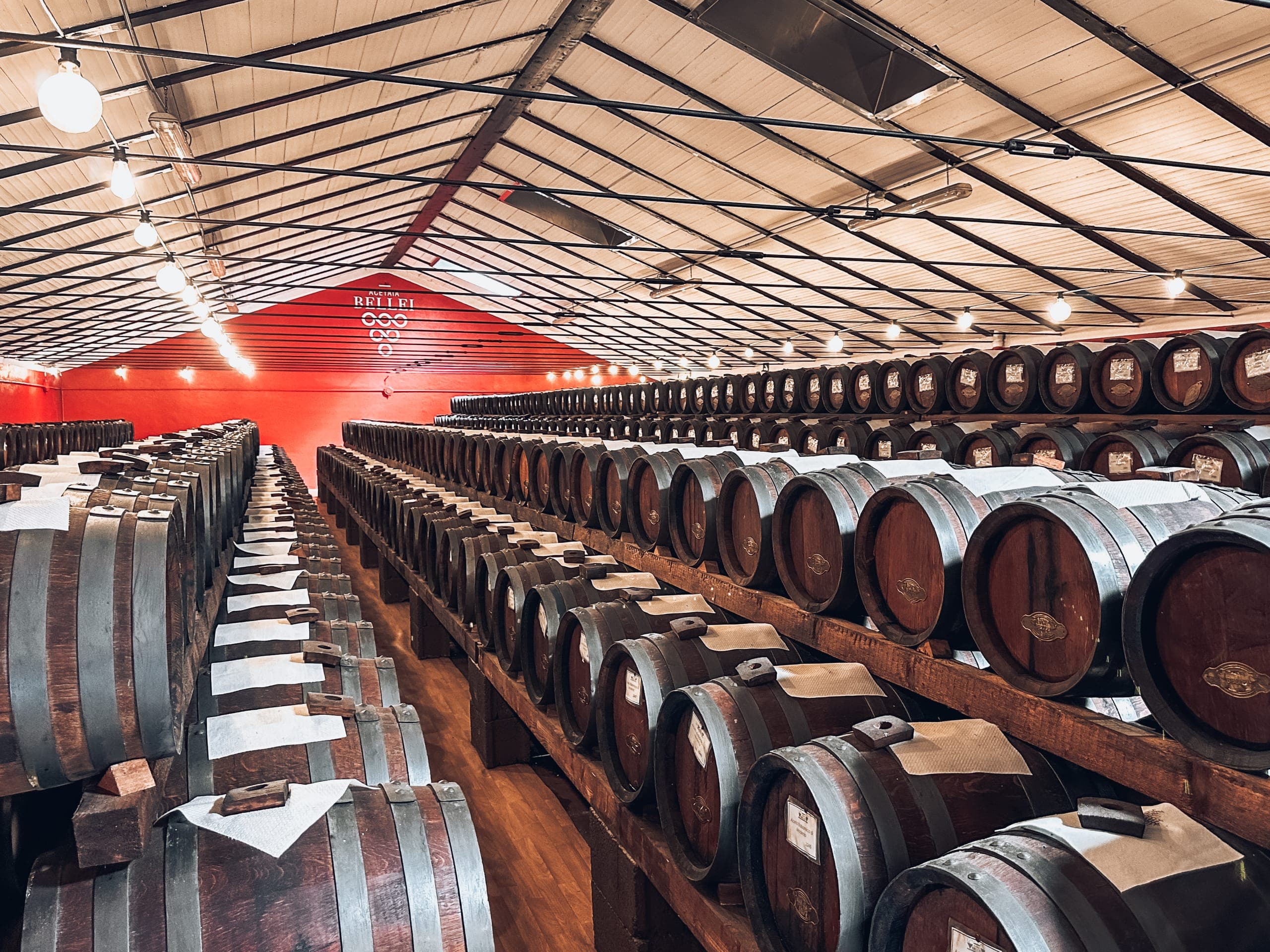
The heart of an acetaia is the battery (batteria): a row of barrels of different woods — oak, cherry, chestnut, mulberry and juniper — arranged in descending size. It starts from cooked must of local Modenese grapes (Lambrusco, Trebbiano, Ancellotta and others), simmered down slowly over open heat until it concentrates into a dark, sweet base.
That must is set to ferment and then to acetify and mature, very slowly, in the wood. Each year part of the contents evaporates through the staves — the loft is deliberately not insulated, so the barrels feel the heat of summer and the cold of winter, which drives the transformation. To make up for what's lost, the producer performs the rincalzo (topping-up): the vinegar is transferred from the larger barrel down to the next, smaller one, and the smallest barrel — which holds the oldest, most concentrated liquid — gives up only a little for bottling. This cycle of travasi e rincalzi ("transfers and toppings-up") runs in a continuous chain that lasts decades.
Each wood lends a different note: oak gives backbone and vanilla, cherry a soft fruitiness, chestnut tannin and colour, mulberry and juniper their own aromatics. The barrels are never emptied completely — the oldest wood and the residue inside it become part of the flavour, which is why an old battery is irreplaceable and cannot simply be bought new.
It's a work of absolute patience, almost always a family's, handed down through generations. A lovely local tradition: many batteries are started for the birth of a child and accompany them for life, so a battery's age is often a person's age. Tending it is a small daily ritual — checking the levels, smelling the barrels, doing the rincalzo once a year, usually in the cold months. Nothing about it can be rushed, and that is exactly the point.
Twelve years, or twenty-five: the two grades
To earn the PDO name takes at least twelve years of ageing. Within the Traditional, there are two official grades you'll see on the bottle:
- Affinato — aged a minimum of 12 years. Already dense and complex, beautifully balanced between sweet and sharp; the everyday face of an extraordinary product.
- Extra Vecchio (Extravecchio) — aged a minimum of 25 years. The absolute summit: thicker, darker, more layered, with a finish that goes on and on.
The more time passes, the denser and more complex it becomes. A young PGI runs like water; a good Affinato coats the back of a spoon; an Extra Vecchio at 25 years and beyond barely pours — you tilt the bottle and let it fall in a slow thread. Producers grade and approve each lot through a panel of master tasters before it can be sealed and sold, so the words on the label are not marketing but a guaranteed minimum.
The bottle designed by Giugiaro
A detail that helps you recognise the real Traditional: by law it is sold exclusively in a distinctive spherical 100 ml bottle, designed by the famous designer Giorgetto Giugiaro — the same man behind some of Italy's most iconic cars. The rounded flask with its rectangular base is unmistakable, and it's bottled only in authorised centres that apply the Consortium's seal. The single approved bottle exists precisely to make counterfeiting harder: if you see a "traditional" balsamic in a different bottle, in a large format, or at a suspiciously low price, it isn't the real PDO.
Producers often distinguish the two grades with a colour code on the closure or label — typically a different cap or capsule for the Affinato (12 years) and for the Extra Vecchio (25 years) — so once you know the shape of the bottle and the seal, you can read a shelf at a glance.
How to use it: drops, never heat
Traditional balsamic is used in drops, raw, never in cooking — heat would destroy in seconds the aromas that took decades to build. A few drops lift a dish without smothering it. Some of our favourite pairings, all of them genuinely Modenese:
- On shavings of aged Parmigiano Reggiano — the textbook pairing, salty crumbly cheese against sweet-sharp syrup. If you try one thing, try this.
- On fresh strawberries, or on vanilla ice cream — dessert in a single gesture; the acidity cuts the sweetness and makes the fruit taste more like itself.
- On a Parmesan or grana risotto at the very end, off the heat.
- On grilled or boiled meats (bolliti), roast beef, or a simple fillet — a few drops at the table.
- Surprisingly, on a wedge of fresh pear, on fried eggs, or even, as some locals swear, neat in a tiny spoon as a digestivo after dinner.
The PGI, by contrast, is the kitchen workhorse: reach for it to dress salads, deglaze a pan, make a quick reduction, or marinate. There it's perfect, and using Traditional for those jobs would be a waste of both the vinegar and the years inside it. Two products, two completely different roles.
Acetaia Giusti and the oldest cellars in Italy
Among the historic names, Acetaia Giusti is the oldest balsamic producer in Italy, with roots going back to the early 1600s (the Giusti family appears in the records from 1605), which is where the "around 400 years" you'll hear comes from. Today it's still run by the same family across many generations, and you can visit its historic cellars and museum just outside the city — a battery room of antique casks, old award medals on the walls, and a tasting that walks you from a young vinegar up to the most aged. It's a beautiful introduction even if you've never thought twice about vinegar in your life.
Giusti is far from alone: the countryside around Modena is dotted with family acetaie, large and tiny, many of which welcome visitors by appointment. Part of the pleasure is exactly that range — you can tour a centuries-old house one day and, the next, climb into a small family loft where the producer pours straight from the barrel their grandfather started.
Visiting an acetaia: what you'll see
The best way to understand balsamic is to see it made and to taste it side by side. Many family acetaie around Modena open their doors for guided visits with tastings, and a typical visit goes roughly like this:
- The loft. You climb up to the sottotetto, the attic where the batteries live under the roof. It's warm, fragrant, and crowded with barrels of descending size, each chalk-marked with a date.
- The story. The producer explains the cooked must, the woods, the rincalzo, and points out which barrels were started for which family member — often a child or a wedding.
- The tasting. You taste straight from the battery, usually comparing a 12-year Affinato with a 25-year Extra Vecchio, sometimes alongside a PGI so the difference lands. You'll do it on a little spoon, then often dropped onto Parmigiano and a strawberry.
- The shop. You leave with a sealed bottle and the name of the people who made it — the antidote to anonymous supermarket bottles.
Visits usually last around an hour, are very child- and beginner-friendly, and almost always need booking ahead, as these are working family businesses rather than big attractions. We're happy to help our guests arrange one and point you to estates that fit your dates.
Acetaie Aperte, every September
Once a year, on a Sunday in September, the region holds Acetaie Aperte ("Open Acetaie") — a day when a large number of estates throw open their doors for free or low-cost tours and tastings. It's the single best chance to wander between several producers, compare styles, and meet the families behind the bottles in one go. If your trip lands in early autumn, build a day around it; it's one of the experiences we most enjoy arranging.
How to recognise and buy it (and avoid fakes)
The market is full of dark, sweet "balsamic glazes" and cheap bottles that borrow the name. Here's how to buy with confidence:
- For the real Traditional, look for the full wording "Aceto Balsamico Tradizionale di Modena DOP", the spherical 100 ml bottle, and the Consortium seal. Anything else calling itself "traditional" in a different bottle is not the protected product.
- Check the grade: Affinato (12 years) or Extra Vecchio (25 years). Both are genuine; the choice is about budget and intensity.
- For everyday use, choose a good aged PGI from a serious producer — ideally one that lists a real density and uses cooked must, not just caramel and thickeners.
- Be sceptical of price. Real Traditional is the fruit of 12 to 25 years in a 100 ml bottle, so it sits firmly in the premium gourmet range — a tiny bottle is meant to be expensive, and a "12-year traditional" for a few euros is a contradiction in terms.
- Buy at the source. Buying directly at the estate (or from a trusted specialist shop) means you avoid imitations, you can taste before you commit, and you bring home the story of the people who made it. It also travels well: the bottle is small, sealed and robust, which makes it the ideal Modena souvenir to carry back to the US or UK.
A note on prices: they vary widely by producer and age, and they change, so we won't quote figures here — taste at the estate and let your palate (and your budget) choose. The honest headline is simply that good Traditional is expensive, and worth it as an occasional luxury, while a fine PGI gives you Modena flavour for everyday money.
Getting to Modena — and to the estates
If you're coming from abroad, Modena is easy to reach and makes a relaxed base for this kind of slow, delicious exploring. The nearest airport is Bologna (BLQ): from there it's roughly under an hour to Modena by train (the Marconi Express monorail links the airport to Bologna Centrale in about 7 minutes, then a regional train runs to Modena in around 30), or about 45 minutes by direct bus, or half an hour by car. On the high-speed network, Florence to Modena is about 1h05 and Milan about an hour, with Bologna just ~30 minutes away by frequent regional trains. Modena's station is a 10-minute walk from the historic centre.
The acetaie themselves are in the countryside ringing the city, a short drive out — easy with a rental car, or arranged with a local guide or transfer if you'd rather taste freely. One practical heads-up for drivers: Modena's old town is a camera-enforced limited-traffic zone (ZTL), so park outside it and walk in. Staying central, as our guests do, means you can stroll the old town in the morning, slip out to an estate in the afternoon, and be back for a tortellini dinner without ever feeling rushed.
Where to stay to discover it
The estates are in the Modena countryside, a short distance from the centre, so staying in the city is the ideal base: it lets you combine an acetaia visit with a stroll through the UNESCO old town, the covered market, and a long dinner. Our apartments are all in central Modena, within walking distance of the cathedral, the Albinelli market and the best places to eat. You book directly with us, with no portal commissions, and we're glad to help you arrange a tasting and tell you which estate suits your dates.
Browse our apartments in Modena and read more about the flavours of Modena and the city's things to see. If you're planning a wider trip, our guide to a day trip to Modena from Bologna shows just how easy it is to fold a balsamic afternoon into a longer Emilia itinerary, and where to stay in Modena helps you pick the right base.
Frequently asked questions
What's the difference between Traditional Balsamic PDO and PGI? Traditional Balsamic of Modena PDO is made only from cooked grape must, aged at least 12 years (25 for the Extra Vecchio) in wooden barrels, and is dense and prized. Balsamic Vinegar of Modena PGI is made with cooked must and wine vinegar, aged from 60 days to 2 years: younger, sharper and cheaper, great for everyday use.
How long is traditional balsamic vinegar aged? Traditional of Modena PDO is aged at least 12 years (the Affinato grade); with at least 25 years it can carry the "Extra Vecchio" designation. Ageing happens in a battery of barrels of different woods, with an annual transfer known as the rincalzo (topping-up).
How do you recognise real traditional balsamic vinegar? Traditional of Modena PDO is sold exclusively in a distinctive spherical 100 ml bottle designed by Giugiaro, with the Consortium's seal. Be wary of low prices and generic labels: real traditional balsamic is rare and expensive.
Can you visit a balsamic estate (acetaia) in Modena? Yes. Many family acetaie open their doors for guided visits with tastings, where you climb into the loft among the barrels and taste straight from the battery. Every September the Acetaie Aperte event opens many estates to visitors.
How do you use traditional balsamic vinegar? In drops, raw: on shavings of Parmigiano Reggiano, on strawberries, on vanilla ice cream, on grilled meats and boiled dishes. You don't cook with it or dress salads as you would with the industrial kind — it's too precious.
How much does traditional balsamic vinegar cost? Traditional Balsamic of Modena PDO is expensive: it's the product of 12 to 25 years of ageing in a 100 ml bottle, so it sits in the premium gourmet range. Prices vary by producer and age, so always check at the estate; the PGI is far cheaper for everyday use.
Is balsamic vinegar from Modena or Reggio Emilia? Both. There are two protected Traditional balsamics: Aceto Balsamico Tradizionale di Modena PDO and Aceto Balsamico Tradizionale di Reggio Emilia PDO. They share the same ancient method; this guide focuses on the Modena one, which you can taste at estates around our city.
Frequent questions
What readers ask us most.
What's the difference between Traditional Balsamic PDO and PGI?
Traditional Balsamic of Modena PDO is made only from cooked grape must, aged at least 12 years (25 for the Extra Vecchio) in wooden barrels, and is dense and prized. Balsamic Vinegar of Modena PGI is made with cooked must and wine vinegar, aged from 60 days to 2 years: younger, sharper and cheaper, great for everyday use.
How long is traditional balsamic vinegar aged?
Traditional of Modena PDO is aged at least 12 years (the Affinato grade); with at least 25 years it can carry the 'Extra Vecchio' designation. Ageing happens in a battery of barrels of different woods, with an annual transfer known as the rincalzo (topping-up).
How do you recognise real traditional balsamic vinegar?
Traditional of Modena PDO is sold exclusively in a distinctive spherical 100 ml bottle designed by Giugiaro, with the Consortium's seal. Be wary of low prices and generic labels: real traditional balsamic is rare and expensive.
Can you visit a balsamic estate (acetaia) in Modena?
Yes. Many family acetaie open their doors for guided visits with tastings, where you climb into the loft among the barrels and taste straight from the battery. Every September the Acetaie Aperte event opens many estates to visitors.
How do you use traditional balsamic vinegar?
In drops, raw: on shavings of Parmigiano Reggiano, on strawberries, on vanilla ice cream, on grilled meats and boiled dishes. You don't cook with it or dress salads as you would with the industrial kind — it's too precious.
How much does traditional balsamic vinegar cost?
Traditional Balsamic of Modena PDO is expensive: it's the product of 12 to 25 years of ageing in a 100 ml bottle, so it sits in the premium gourmet range. Prices vary by producer and age, so always check at the estate; the PGI is far cheaper for everyday use.
Is balsamic vinegar from Modena or Reggio Emilia?
Both. There are two protected Traditional balsamics: Aceto Balsamico Tradizionale di Modena PDO and Aceto Balsamico Tradizionale di Reggio Emilia PDO. They share the same ancient method; this guide focuses on the Modena one, which you can taste at estates around our city.
Eat properly, then walk home.
Mercato Albinelli, the trattorias of the old town and the Lambrusco counters are all minutes from our apartments. After a dinner like that, not having to drive is half the pleasure.