Albinelli Market in Modena: Hours, Stalls and What to Buy
FNFrancesco NoliThe short answer
Modena's Albinelli Market is a covered food market of 55 traders — 49 stalls plus six bars and restaurants — built in 1931 and open to anyone, free, with no ticket. The stalls run Monday to Saturday from 7am and close in the early afternoon; from mid-September to the end of May they stay open until 7pm on Saturdays. They do not open on Sundays, which is when most visitors try. The six restaurants inside serve lunch and dinner seven days a week, including Sunday.
The Albinelli Market opens at seven and shuts by mid-afternoon, closed all day Sunday. What to buy, what it costs, and how to use it without a kitchen.
Most people get the Albinelli Market wrong in exactly one way: they turn up in the afternoon. Modena's covered food market opens at seven in the morning and the shutters start coming down over lunchtime, so a visitor who spends the morning at the cathedral and drifts over at three finds an empty hall and a few restaurant tables. On Sunday — the day most people have free — the stalls do not open at all.
Get the timing right and it is an hour well spent. What follows is what is sold there, what it costs, how to buy food with nowhere to cook it, and what customs will let you take home. Checked in August 2026 against the market's own site and official sources — and where those contradict each other, which they do on the hours, this guide says so rather than picking the convenient version.
The hours, and the contradiction inside them
Here is the awkward part. The market's official hours page states the stalls trade Monday to Saturday, 07:00-15:00. Two other pages on the same official site — the location page and the contacts page — state Monday to Friday 07:00-14:00 and Saturday 07:00-18:00. Visit Modena agrees with the first version.
We are not going to pretend that is settled. What we tell guests is the version that cannot go wrong: treat 14:00 as your deadline. Either way you have not wasted a trip, and in both versions stallholders pack up when they have sold what they brought, so the last hour is thinner than the first.
| Stalls | Restaurants and bars | |
|---|---|---|
| Monday to Friday | from 07:00, closing between 14:00 and 15:00 | 12:00-15:00 and 18:30-23:00 |
| Saturday, 1 June to 14 September | from 07:00, closing between 14:00 and 15:00 | 12:00-15:00 and 18:30-23:00 |
| Saturday, 15 September to 31 May | from 07:00 until 19:00 | 12:00-15:00 and 18:30-23:00 |
| Sunday | closed | 12:00-15:00 and 18:30-23:00 |
The extended winter Saturday is the good news for weekend visitors, and two independent sources confirm it: from 15 September to the end of May the stalls stay open until 19:00 on Saturdays.
The restaurants inside keep their own hours and open seven days a week. A Sunday visit is not pointless — you simply cannot shop.
The stalls also close on public holidays: in 2026, 25 April, 1 May, 2 June, 15 August, 1 November, 25, 26 and 31 December.
One more warning: the hours published by travel aggregators are frequently wrong — we have seen "Tuesday to Saturday 7:30-13:30, closed Sunday and Monday" on sites that rank well. The market trades on Mondays. Use its own site, or ask us.
What the market actually is
It is a covered hall of 55 traders — 49 food stalls plus six bars and restaurants — occupying a block off via Luigi Albinelli, five minutes' walk from Piazza Grande. Entry is free: no ticket, no guided visit, no turnstile.
You will see "65 traders" quoted in several places, including one page of the market's own site. Counted one by one, the trader listings come to 55, which is also the figure on its history page.
It was inaugurated on 28 October 1931, designed by the city's technical office with the engineer Eugenio Marchi — a name almost no secondary source records. Before it existed, Modena's market happened outdoors in Piazza Grande. The push for a covered hall came from Luigi Albinelli, mayor from 1900 to 1908, who wanted the trade under a roof for hygiene, freshness and order; the building opened twenty-three years after he left office and carries his name.
Architecturally it is late Liberty — Italian Art Nouveau — and the material to notice is iron and cast iron: slender pillars, metal roof trusses, toothed canopies, light coming down through the roof. Several shopfronts still carry their original black and gold signs, and near the restaurants you can see the old fish counters in pale Verona marble.
In the middle stands a travertine fountain topped by a bronze girl with a basket of fruit — Fanciullina con canestro di frutta, by the Modenese sculptor Giuseppe Graziosi. It was there to wash fruit and vegetables; it became the place people arrange to meet. If someone says "at the fountain", this is the fountain.
The market is a recognised site of national historic interest. Its own history page dates that to 1997, Visit Modena to 1990. Take the recognition and leave the year.
Can you walk in, look, and take photographs?
Yes to all three, and worth saying plainly, because visitors hover at the entrance wondering whether they are allowed in without buying. You are: it is a public market, nobody will approach you, and browsing before deciding is what half the Modenese in the hall are doing.
Photography: no published policy, no signs prohibiting it. The one courtesy worth observing is to ask before photographing a stallholder or leaning in over their counter, especially between 9 and 11 on a Saturday when three people are waiting behind you.
Language: several traders deal with visitors daily and manage in English; several conduct their entire working life in Modenese dialect. Pointing works, and "cento grammi" is the most useful phrase in the building.
What is on sale: the thirteen categories
The market is organised into thirteen official categories. Knowing which is which saves walking the hall twice.
| Category | Stalls | What it is worth going for |
|---|---|---|
| Fruit and vegetables | 9 | Ready-cut salads, soups and minestrone to boil, mushrooms and local truffle |
| Delicatessen and cured meats | 7 | Prosciutto crudo, coppa, bresaola, mince for ragù, sliced to order |
| Cheese | 6 | Parmigiano Reggiano at different ages, cut from the wheel |
| Butchers | 5 | Beef, pork, poultry, rabbit and game — plus a dedicated horse-meat butcher |
| Bakery | 6 | Sourdough, focaccia, gnocco, the local bensone |
| Prepared food | 4 | Roast meats, fish dishes, and one entirely vegan stall |
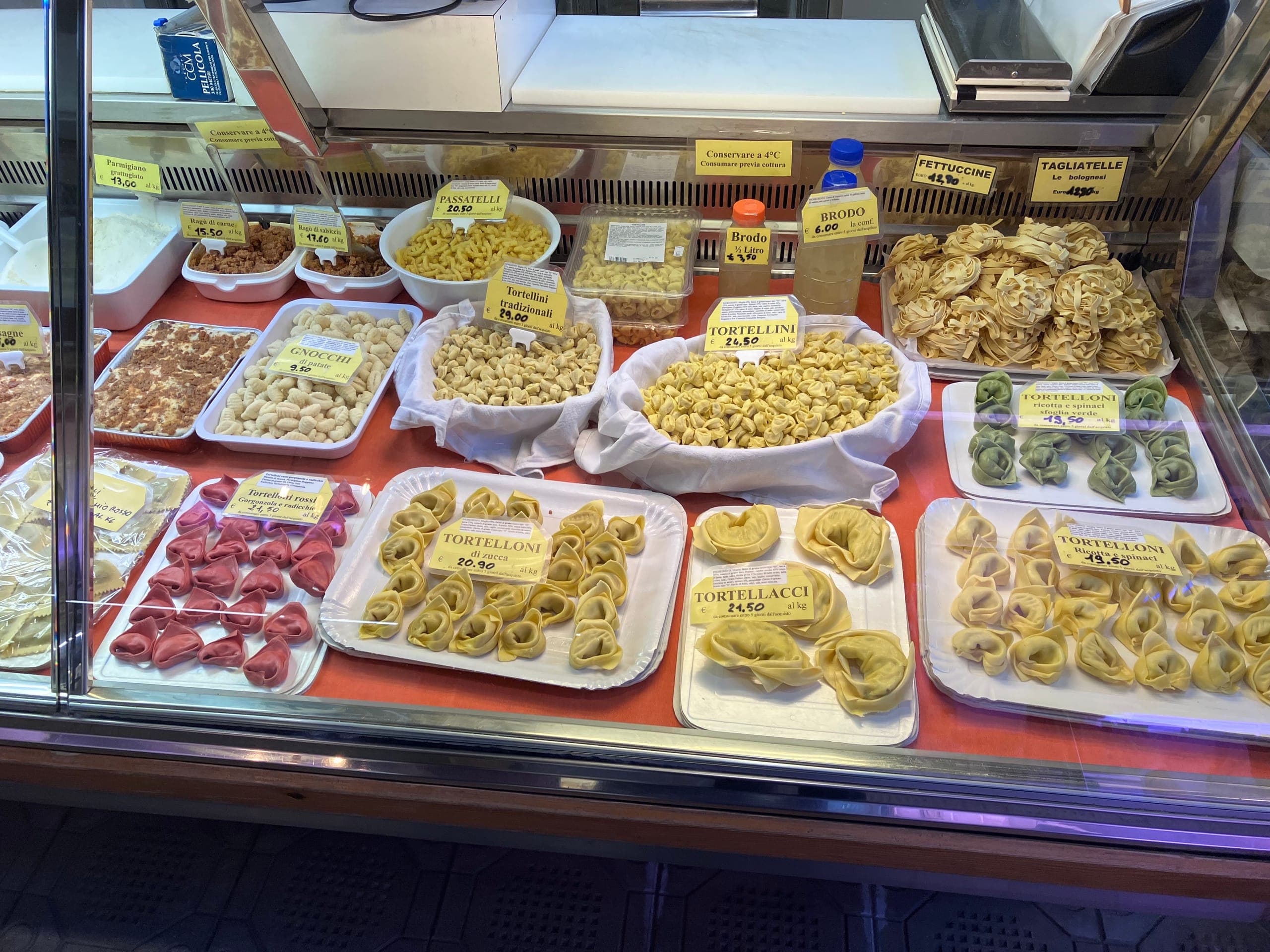
| Fresh pasta | 3 | Tortellini, tortelloni, passatelli, tagliatelle, gluten-free too |
| Fishmongers | 2 | Adriatic fish, delivered daily |
| Sweets and specialities | 4 | Preserves, pastries, confectionery |
| Grains and spices | 1 | Flours, spices, dried and cooked pulses, rice, nuts — bring your own containers |
| Wine and drinks | 1 | Wine, mineral water, juices and soft drinks |
| Newsstand | 1 | Papers, city maps, and the taxi booking point |
| Bars and restaurants | 6 | Sit-down lunch and dinner, seven days a week |
Four notes on that table, because it holds the things that surprise people.
Fresh pasta is not confined to the pasta category. Three stalls are classed as pasta producers, but hand-made tortellini are also sold by three cheese counters and one delicatessen. If the pasta stall has a queue, look sideways.
There is a horse butcher, and it is not a curiosity for tourists — horse is normal Emilian cooking, and the stall sells raw cuts and ready-to-heat dishes.
There is an entirely vegan stall — veg burgers, almond and cashew cheeses, vegan tortellini — and one selling Chinese takeaway. A market trading continuously since 1931 is not a museum.
There are no flower stalls. The thirteen categories do not include florists and none of the 55 traders sells flowers. If you have read otherwise, including on this site, it was wrong.
Two counters do tastings as part of their ordinary trade rather than as a booked experience: one for Balsamic Vinegar of Modena PGI and traditional balsamic, one for artisan salami and natural wines. Beyond that, a sliver of cheese offered to someone deciding is a courtesy, not a service you request.
Buying food when you have nowhere to cook it
This is the question we get most from guests staying one night, and a market is more useful without a kitchen than people assume.
What needs no cooking, no equipment and no plan:
- Cured meat, cut to order and wrapped in paper. Ask for cento grammi — a hundred grams is roughly one person's starter.
- Parmigiano Reggiano, cut off the wheel. Ask for 24 or 30 months, say it is to eat rather than to grate, and ask for it vacuum-sealed (sottovuoto) if it is going in a suitcase.
- Bread, from any of the six bakers — what turns the two items above into lunch.
- Prepared dishes from the gastronomy counters: roast meats, cooked vegetables, seafood, vegan dishes, sold by weight in a tub.
What is a trap without a kitchen: fresh pasta. Tortellini are the thing everybody wants to buy and the thing most likely to end up in a hotel bin — they need boiling water and, properly, broth. Eat them at a table instead, inside the market or at one of the trattorie we send guests to.
The small-order question. Asking for a hundred grams is not rude in a market where the person ahead bought two kilos: everything is cut and weighed to order. What is unwelcome is joining a queue at 09:00 on a Saturday and then spending four minutes deciding.
Several stalls deliver within Modena and a few ship further, arranged with the trader directly rather than through the market.
Eating inside the market
Six places inside the hall serve food, and they are why the building has a life after the stalls close: seven days a week, roughly 12:00-15:00 and 18:30-23:00.
| Place | What it does |
|---|---|
| Bar Schiavoni | The historic bar: coffee, gourmet sandwiches, wine. Salt-cod fritters on Wednesdays and Fridays |
| Alvinelli | Natural wines by the glass, with a kitchen |
| Antica Bottega | Traditional regional plates, aperitivo, small dishes |
| Artigiani del Gusto | Wine shop and food specialities eaten on the spot |
| MozzaBella | Pizza, fried pizza, sharing boards |
| Salsedine | Fish cooking, plus gnocco fritto and tigelle |
The market's own hours page calls these times indicative and tells you to check with the individual place — sensible, since these are six independent businesses, not a food court. Phone numbers are on the market's contacts page.
Worth knowing too: Trattoria Aldina is effectively above the market, first floor at via Albinelli 40 — lunch only, no bookings. The hours, the queue and the rest of the trattorie are in our guide to eating in Modena.
You will read elsewhere — including, until we corrected it, on our own site — that the market reopens on Friday and Saturday evenings, 18:00 to midnight, with food stalls. We cannot confirm that against any official source for 2026. What is verifiable is that the market has an evening life through those six restaurants, until 23:00, every day, and that the balsamic counter also serves lunch as a restaurant seven days a week.
What it costs, and how to pay
On prices we will disappoint you slightly, on purpose. Neither the market nor its traders publish a price list, and we will not invent numbers and attach them to a real business. What follows are Italian market ranges for the same goods — a sense of scale, not prices recorded at these stalls.
| Item | Indicative Italian range |
|---|---|
| Hand-made fresh tortellini | €30-36 per kg |
| Industrial supermarket tortellini, for comparison | €15-20 per kg |
| Parmigiano Reggiano, 24 months | €20-28 per kg |
| Parmigiano Reggiano, 36 months | €25-32 per kg |
| Espresso standing at the counter | €1.50-2.00 |
The gap between the first two lines is the argument for coming here: hand-rolled tortellini cost roughly double the industrial ones, and the difference is a person who was folding them at six this morning.
Cards or cash? Both work. Since 30 June 2022 Italian merchants have been required to accept electronic payment, with a fine of €30 plus 4% of the transaction for refusing. Still, carry €20-30 in cash: a queue moves at the speed of its slowest transaction, and for a €4 purchase notes are faster.
When to go, hour by hour
| Time | What it is like |
|---|---|
| 07:00-08:00 | Traders setting up. Half the stalls are not ready |
| 08:00-10:00, weekday | The best hour. Fully stocked, locals shopping, no crowd |
| 10:00-12:00 | Steady, slightly busier |
| 09:00-12:00, Saturday | The busiest window of the week |
| 12:00-13:30 | Shopping thins out, restaurants fill up. Best time to eat |
| After 14:00 | Risky. Stalls start closing, some have sold out |
| Sunday | Restaurants only |
Go early on a Tuesday and you will see more shopping bags than cameras. Go at eleven on a Saturday and you will see the opposite, plus a queue.
The figure usually quoted for footfall is around 30,000 people a week, and the city counted 160,000 entries over the Christmas period, 1 December 2025 to 6 January 2026. It is busy. By the standards of covered markets in bigger cities it is not oppressive.
Getting there, and why you should not drive
The address is via Luigi Albinelli 13, with three entrances: via Albinelli 13, the main one, with step-free access; via Mondatora on the north side; and Piazza XX Settembre.
On foot it is five minutes from Piazza Grande and eight from via Emilia Centro. SETA buses 7, 11 and 12 stop at via Emilia Centro near the main entrance.
Do not drive to it. The historic centre is a camera-enforced limited traffic zone, the market is inside it, and the fine arrives weeks later — or, with a rental car, as a mystery charge on your card first. Our guide to Modena's ZTL explains who may enter and our parking guide where to leave the car; the underground park at Parco Novi Sad is about ten minutes' walk.
The newsstand inside the market is also the taxi booking point — Radiotaxi Modena Cotamo, with a euro off the fare for booking there — which is more useful than it sounds when you are standing with four bags.
Taking it home: what customs will and will not let you keep
This is the section nobody writes, and it decides whether your €40 of prosciutto reaches your kitchen or an airport bin.
Flying home within the EU. Hard cheese is a solid, so vacuum-packed Parmigiano can go in your cabin bag. Balsamic vinegar, Lambrusco and anything liquid falls under the 100ml cabin rule and goes in checked luggage — see the EU's summary of luggage restrictions. Buy the vinegar last and pack it in the middle of your clothes.
Flying to Great Britain. Under the current rules on bringing food into Great Britain, travellers cannot bring in cheese, milk or dairy, or pork, beef, lamb, mutton, goat or venison from EU countries for personal use. That is not a technicality about quantity but a prohibition, in force since April 2025 as a foot-and-mouth measure, and it covers vacuum-packed Parmigiano and a prosciutto sandwich alike. Fish, poultry, eggs and honey are allowed. If you are British, buy the balsamic and eat the cheese here.
Flying to the United States. The pattern reverses: hard cured cheeses such as Parmigiano are generally admissible, while cured ham and salami from Italy are not, regardless of vacuum packing or commercial labelling, because of European foot-and-mouth risk. Everything agricultural must be declared on arrival: declaring something inadmissible costs you the item, not declaring it costs you a fine. Check the USDA APHIS traveller pages before you spend money, because these rules move with outbreaks.
The practical conclusion: eat the meat in Modena and take home what travels — balsamic vinegar, a bottle of Lambrusco, dried pasta, nocino, torta Barozzi in its box.
What is not worth it, and who this market is not for
The honest part.
- It is not for you if you cannot get there before two in the afternoon. No amount of enthusiasm fixes a closed market. If your day only frees up later, go to the restaurants inside or skip it — an empty hall photographs well and tells you nothing.
- It is not a street-food market. It is a shopping market with six restaurants attached. If your reference point is Borough Market, adjust down on entertainment and up on ingredients.
- Do not come for a cooking class or a guided tasting. Neither exists here as a scheduled programme — two counters taste as part of their normal trade, and that is all. Anyone selling an "Albinelli tasting tour" is packaging a walk through a public building.
- It is not the first call on your only morning. The cathedral, the Ghirlandina and Piazza Grande come first — our one day in Modena itinerary puts the market in as a thirty-minute stop, which is the right size. With two days, give it a proper hour.
- Prices are not cheap. This is artisan food sold by the people who make it, and it is not competing with a supermarket.
- If raw meat and whole fish bother you, some of this hall will. Whole rabbits, game birds, a horse butcher, and a fish counter that smells like one.
- Saturday morning is the worst time to talk to anyone. If you came to have someone explain the difference between 24 and 36 months, come on a Tuesday.
Coming in October 2026
If your trip is flexible: 28 October 2026 is the market's 95th birthday, to the day since the 1931 inauguration, already on the official events calendar as I 95 anni del Mercato Albinelli. Late October also means the extended Saturday hours are back.
Where to stay
A shopping market is a different proposition depending on whether you go home to a hotel room or a kitchen. Our guests come back with paper packages and a bottle, which is a large part of why they book an apartment. All four of our places are in the historic centre and you book directly with us, with no platform commission. Before you arrive we tell you what is open on your dates — around Christmas and in mid-August that is half the problem.
Two of the four are inside the restricted traffic zone, where we handle the daily access permit at €10 a day if you are driving. The other two are on the ring boulevards, where no permit is needed and you park at the door — Modena Prestige is on the ground floor with public parking in front.
Closest to the market is the attic on Piazza Mazzini, a few minutes from the via Albinelli entrance, sleeping up to eight — which matters, because a market shop argues for cooking one meal together rather than booking a table for eight.
See all our apartments in Modena, or where to stay in Modena if you are still choosing an area.
Read next
The flavours of Modena explains what you are looking at, and balsamic vinegar covers the one bottle worth carrying home — with a Parmigiano dairy tour and visiting a balsamic producer for the mornings outside town. For eating rather than shopping: where to eat in Modena and gnocco fritto and tigelle. Coming for the day, Modena as a day trip from Bologna is built around market hours.
Frequently asked questions
What time does the Albinelli Market close? Early. The market's own hours page gives Monday to Saturday 7:00-15:00, while two other pages on the same site say 7:00-14:00 on weekdays. Either way the shutters come down over lunchtime and stallholders leave when they have sold out. Treat 14:00 as your deadline. From 15 September to the end of May, Saturdays are the exception: open until 19:00.
Is the Albinelli Market open on Sundays? The stalls are not. Sunday is the one day the food market does not trade at all, and it is the day most visitors have free — which is why so many arrive to find a closed building. The six bars and restaurants inside do open on Sundays, lunch and dinner. You just cannot shop.
Can I take photographs inside the market? Yes. There is no published photography policy and no signs prohibiting it, and the building — iron pillars, painted shopfronts, the fountain in the middle — is why many people come. The courtesy that costs nothing is to ask before pointing a camera at a stallholder, particularly on a Saturday morning when there is a queue behind you.
Can I buy food at the market if I don't have a kitchen? Easily. Cured meats and cheese are cut to order and wrapped, bread comes ready, and several stalls sell prepared food: roast meats, cooked vegetables, salads, soups, vegan dishes, fish gastronomy. Nobody minds a small order — a hundred grams of prosciutto is a normal request. If you want it cooked for you, the six places inside serve at a table.
Do the stalls take cards, or do I need cash? Cards are accepted. Since 30 June 2022 Italian merchants have been legally required to accept electronic payment, with a fine for refusing. In practice, carrying €20-30 in cash still makes small purchases faster, and it is what the locals ahead of you will be using.
Is the Albinelli Market a tourist market? No, and that is checkable rather than a matter of opinion. It closes in the early afternoon and all day Sunday — two things a market built for visitors would never do — and its trade is raw ingredients: whole fish, rabbit, horse meat, dried beans, flour. Tourists are welcome, but the market is not arranged around them.
Can I take Parmigiano and prosciutto home to the US or the UK? Cheese and cured meat travel very differently. Travellers to Great Britain cannot bring cheese, dairy, pork, beef or lamb from the EU at all under current rules. Travellers to the US generally may bring hard cheeses such as Parmigiano, but cured ham and salami from Italy are not admissible, and everything must be declared. Check the official guidance for your destination before you buy.
When is the best time of day to go? Between 8:00 and 10:00 on a weekday. The stalls are fully stocked, the customers around you are Modenese doing the shopping, and nobody is in a hurry. Saturday morning is the busiest slot of the week and the least useful if you want to talk to anyone. Around 12:30 the character changes: the shopping thins out and the restaurants inside fill up.
Frequent questions
What readers ask us most.
What time does the Albinelli Market close?
Early. The market's own hours page gives Monday to Saturday 7:00-15:00, while two other pages on the same site say 7:00-14:00 on weekdays. Either way the shutters come down over lunchtime and stallholders leave when they have sold out. Treat 14:00 as your deadline. From 15 September to the end of May, Saturdays are the exception: open until 19:00.
Is the Albinelli Market open on Sundays?
The stalls are not. Sunday is the one day the food market does not trade at all, and it is the day most visitors have free — which is why so many arrive to find a closed building. The six bars and restaurants inside do open on Sundays, lunch and dinner. You just cannot shop.
Can I take photographs inside the market?
Yes. There is no published photography policy and no signs prohibiting it, and the building — iron pillars, painted shopfronts, the fountain in the middle — is why many people come. The courtesy that costs nothing is to ask before pointing a camera at a stallholder, particularly on a Saturday morning when there is a queue behind you.
Can I buy food at the market if I don't have a kitchen?
Easily. Cured meats and cheese are cut to order and wrapped, bread comes ready, and several stalls sell prepared food: roast meats, cooked vegetables, salads, soups, vegan dishes, fish gastronomy. Nobody minds a small order — a hundred grams of prosciutto is a normal request. If you want it cooked for you, the six places inside serve at a table.
Do the stalls take cards, or do I need cash?
Cards are accepted. Since 30 June 2022 Italian merchants have been legally required to accept electronic payment, with a fine for refusing. In practice, carrying €20-30 in cash still makes small purchases faster, and it is what the locals ahead of you will be using.
Is the Albinelli Market a tourist market?
No, and that is checkable rather than a matter of opinion. It closes in the early afternoon and all day Sunday — two things a market built for visitors would never do — and its trade is raw ingredients: whole fish, rabbit, horse meat, dried beans, flour. Tourists are welcome, but the market is not arranged around them.
Can I take Parmigiano and prosciutto home to the US or the UK?
Cheese and cured meat travel very differently. Travellers to Great Britain cannot bring cheese, dairy, pork, beef or lamb from the EU at all under current rules. Travellers to the US generally may bring hard cheeses such as Parmigiano, but cured ham and salami from Italy are not admissible, and everything must be declared. Check the official guidance for your destination before you buy.
When is the best time of day to go?
Between 8:00 and 10:00 on a weekday. The stalls are fully stocked, the customers around you are Modenese doing the shopping, and nobody is in a hurry. Saturday morning is the busiest slot of the week and the least useful if you want to talk to anyone. Around 12:30 the character changes: the shopping thins out and the restaurants inside fill up.
Eat properly, then walk home.
Mercato Albinelli, the trattorias of the old town and the Lambrusco counters are all minutes from our apartments. After a dinner like that, not having to drive is half the pleasure.