Lambrusco Wine: Why the One You Know Is Sweet, and the One We Drink Is Not
FNFrancesco NoliThe short answer
Lambrusco is a dry sparkling red from the plains around Modena, and the sweet version most Americans know is a genuine but separate product: from 1976 to 2000 Riunite was the number one imported wine in the United States, peaking at 11.5 million cases in 1985, and it was made sweet deliberately for that market. In Modena the everyday bottle is secco — up to 4 grams of residual sugar. Three denominations matter: Sorbara, pale and sharp, for cured meats; Grasparossa di Castelvetro, dark and structured, for fried dough and rich pasta; Salamino, the middle ground.
Sparkling red from Modena: the three denominations, how to read the label, what to drink it with, and where to taste it where it is actually made.
If you grew up in the United States, there is a decent chance your parents had a bottle of Lambrusco in the fridge door, and a decent chance it was sweet. That memory is accurate, and it is also the reason most visitors arrive in Modena expecting something we do not drink here.
Both wines are real. What follows is what Lambrusco is where it is made, how to tell the styles apart on a label, what to eat with it, and where to taste it in the city and in the countryside where the vines are. We write this from the middle of the production area — the vineyards start about ten minutes from our front doors.
Why the Lambrusco you know is sweet
This is not an accident of taste, it is a business decision made fifty years ago, and the numbers are remarkable.
From 1976 to 2000, Riunite was the number one imported wine in the United States. It peaked in 1985 at 11.5 million cases. In 1981 Americans drank around 135 million bottles of it, and roughly one in every four bottles of imported wine sold in the country was Riunite. The advertising campaign — "Riunite on ice, that's nice" — is still remembered by people who have never thought about Emilian wine since.
The cooperative had found the formula in 1967, with an amabile style built for American palates of the time. Faced with export demand at a scale Emilia had never seen, producers realised that sweet, lightly fizzy Lambrusco made in tanks could be produced cheaply, in enormous volume, and shipped profitably.
So an entire generation abroad learned that Lambrusco means sweet, cheap and served over ice — while in Modena the wine on the table stayed dry, because it had a job to do next to a plate of cured pork.
What Lambrusco actually is
Lambrusco is a red sparkling wine made from grape varieties that share the name — there are several, and each denomination is built on a different one. Most of it is frizzante, lightly sparkling, rather than fully sparkling spumante, and most of it is made in pressurised tanks: fast, clean, and suited to a wine meant to be drunk young.
A smaller and growing category is metodo classico, fermented in the bottle like Champagne, and it is a different animal: finer bubbles, more depth, a price to match.
It is served cool, around 12 to 14 degrees — not ice cold, and certainly not on ice. And it is a food wine in the strictest sense: on its own it can seem lean and austere, and next to fatty, salty food it makes sense immediately.
The three denominations that matter around Modena
The province has several DOC denominations, and neighbouring Reggio Emilia has its own. For a visitor, three names carry the difference.
| Denomination | Where | Style | Drink it with |
|---|---|---|---|
| Lambrusco di Sorbara | the plain north of Modena | pale, almost rosé, sharp acidity, low tannin | prosciutto, mortadella, salami, tortellini in broth |
| Grasparossa di Castelvetro | the hills south of the city | dark, structured, firm tannin | gnocco fritto, tigelle, ragù, boiled meats |
| Salamino di Santa Croce | around Carpi, north | between the two, medium body | a whole meal on one bottle |
Sorbara is the one that surprises people: so pale it can look like a rosé, with acidity that cuts fat like a knife. It is what a Modena family opens with a plate of cured meat.
Grasparossa comes from the hills around Castelvetro, and it is the opposite: deeper colour, grip, structure. It is the bottle for fried dough and for anything with ragù.
Salamino is the compromise, and there is no shame in that: if you are ordering one bottle for four people eating different things, it is the safe answer.
How to read the label
The single most useful thing on a Lambrusco label is the sweetness declaration, and it is regulated.
| On the label | Residual sugar | What to expect |
|---|---|---|
| Secco | up to 4 g/l, or up to 9 where acidity balances it | what people drink at the table here |
| Abboccato / semisecco | up to 12 g/l, up to 18 with matching acidity | noticeably softer |
| Amabile | up to 45 g/l | openly sweet, for the end of a meal |
| Dolce | over 45 g/l | dessert wine, not lunch |
If you want the version this city drinks, look for secco and a DOC denomination. If you loved the sweet one — and plenty of people do, without apology — amabile is what you are looking for, and it is still made.
What to drink it with
Lambrusco was built for the food of this plain, which is fatty, salty and rich. That is the whole design.
| If you are eating | Order | Why |
|---|---|---|
| Cured meats, prosciutto, mortadella | Sorbara | acidity cuts the fat without weighing anything down |
| Gnocco fritto, tigelle, spalla cotta | Grasparossa | fried dough needs structure and tannin |
| Tortellini in broth | Sorbara or Salamino | broth wants lightness, not grip |
| Tagliatelle al ragù, bollito, zampone | Grasparossa | rich plates that carry a fuller wine |
| Before dinner, with something salty | Sorbara or a metodo classico | dry and taut, does not tire the palate |
What it does not do is stand in for a big red at a steak dinner, and it is not built for sipping alone on a terrace. Our guides to the flavours of Modena and to gnocco fritto and tigelle cover the food side of these pairings.
Where to taste it in Modena
In the city, wine bars rather than cocktail bars are where Lambrusco is poured by the glass and chosen by label. A few with published details:
| Place | Address | Hours as published | What you do there |
|---|---|---|---|
| Molto | via dei Gallucci 1 | daily 18:00-00:30 | glass or bottle to take away |
| Stappiamo | via Sant'Eufemia 48 | from 17:30 | glass, small plates |
| Altro Bottega | piazza San Francesco | from 18:00 | glass, local labels |
| Vinoteca Modena | viale Ciro Menotti 217 | its site says closed Sat and Sun | glass, and wine loose from the tank |
| Enoteca Ducale | corso Vittorio Emanuele II 15/17 | shop hours, Mon closed | buying, tastings by appointment |
One warning worth repeating: hours at small places here change, and some sources disagree with each other — Vinoteca's own site says closed at weekends while directories say otherwise. Phone before you walk across town.
A glass costs €5 to €7 in the city. If you would rather have the full evening context — where people actually go and at what time — that is in our guide to where to eat, which also explains the local timing: kitchens open around 19:30, and the drinking window before that is short.
Visiting a producer
This is the part that makes the trip, and it works like the balsamic producers: small family estates, visits by appointment, no ticket desk.
| Estate | Where | From Modena | Booking |
|---|---|---|---|
| Villa di Corlo | Baggiovara | 6.7 km, 10 min | +39 059 510736 |
| Paltrinieri | Sorbara | 15 km, 20 min | +39 059 902047 |
| Garuti | Sorbara | 15 km, 20 min | +39 059 902021 |
| Cantina della Volta | Bomporto | 18 km, 24 min | +39 059 7473312 |
| Fattoria Moretto | Castelvetro | 19 km, 27 min | +39 059 790183 |
Sorbara is the place to go if you want to understand the pale style — Paltrinieri and Garuti are both there, in the flat land north of the city. Cantina della Volta at Bomporto is where to go for metodo classico, the bottle-fermented style. Fattoria Moretto is up in the Castelvetro hills, which is also the prettiest drive of the five.
All of them need a car or a taxi: unlike the one balsamic producer reachable by city bus, the Lambrusco estates sit in farmland. If you are staying with us we will make the call and fix a time — we take no cut on that, we just know the numbers.
Half a day in the Lambrusco country
If you have one free morning and a car, this is the loop we suggest — and it works better than a single long tasting, because the two styles are made in two different landscapes.
North, to Sorbara. Twenty minutes across flat farmland to the villages that give the pale style its name. Book one estate for mid-morning; a tasting takes about an hour, standing among the tanks, and usually ends with the producer opening something that is not on the price list. This is also the area where the ground is sandy and the vine struggles, which is the reason the wine comes out so pale and so sharp.
Back for lunch in the city, because the wine you just tasted belongs next to a plate of cured meat, not next to nothing.
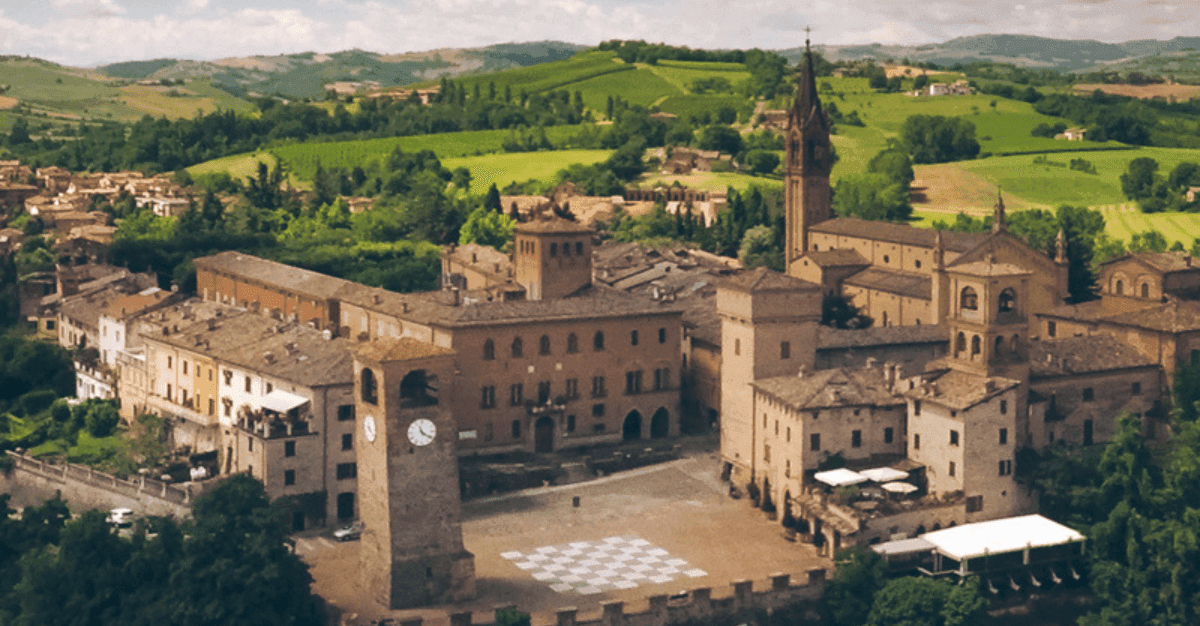
South, to Castelvetro, if the afternoon holds. Half an hour into the hills, where Grasparossa grows and the landscape stops being flat: vineyards on slopes, a village with a chequerboard square, and a completely different wine from the one you drank in the morning. The village itself is covered in our day trips guide.
Two estates in a day is the sensible maximum. A third and you stop tasting and start drinking, which is a different activity and one that does not go well with driving.
Why it grows here, and nowhere quite like it
Lambrusco is not a marketing creation: the vine has been documented in this part of the Po plain for a very long time, and the Romans wrote about wild vines in the area. What matters for the glass in front of you is the ground.
The plain around Modena is alluvial — sand, silt and clay left by rivers coming off the Apennines — and it is fertile, flat and damp. That combination produces high yields and grapes with plenty of acidity and moderate sugar: exactly the raw material for a light, sharp, sparkling red, and exactly the wrong material for a dense, tannic still wine. The hills south of the city are a different story: less water, more slope, more concentration, which is why Grasparossa has grip where Sorbara has cut.
In other words the wine is the way it is because the place is the way it is — and that is also why the sweet export version, whatever you think of it, is a departure from the ground rather than an expression of it.
What it costs
| Loose from a cooperative tank | €1.55-1.85 per litre |
| Basic cooperative bottle | a few euros |
| Serious DOC bottle | €10-15 in a city wine shop |
| Metodo classico | €20-30 |
| A glass in a wine bar | €5-7 |
The loose wine is not a curiosity: cooperative cellars fill your container from the tank, and it is what a lot of families drink at home during the week. It is also the cheapest way to understand why this wine exists.
Taking it home
Bottles go in checked baggage — they are far over the cabin liquid limit, and unlike the 100ml balsamic bottle there is no trick here. Wine is admissible into both the United States and the United Kingdom within personal allowances, and must be declared where the rules require it.
Two practical notes. Wrap it properly: this is glass under pressure, and a Lambrusco bottle that breaks in a suitcase ruins more than itself. And buy where you tasted, at the estate or a city wine shop, rather than at the airport: the price is better and the label is one you have actually tried.
What not to expect
- It is not a big red. Low alcohol, fizz, acidity: it does what it does, and if you want Barolo, this is not a substitute.
- It is not a sipping wine. Without food it can read as thin or sharp. With a plate of mortadella it makes immediate sense.
- Do not order it on ice. Cool, not iced. The American serving ritual came with the sweet export version and has nothing to do with the wine here.
- The estates are not visitor centres. They are working farms with a phone, not a booking platform, and someone in the family shows you around.
- If you loved the sweet version, say so. There is a snobbery about Lambrusco dolce that we find tiresome: it is an honest style, it made this region's fortune abroad, and any decent wine shop here will sell you a good one without a lecture.
Where to stay
Modena sits in the middle of the production area: the Sorbara vineyards are twenty minutes north, the Castelvetro hills half an hour south, and the city itself is where the wine shops are.
Our four apartments are all in the historic centre and are booked directly with us, with no platform commission. For a wine trip the useful distinction is the car: Modena Prestige and Vista Ghirlandina sit on the boulevards outside the limited traffic zone, with public parking in front of the door, so you can drive out to the estates and back without permits. The other two are inside the walls, minutes from the wine bars. All of them are on the apartments page.
Tell us your dates and we will phone the estates for you — which producer is open, at what time, and whether they speak English.
Read next
The other great product of this province works the same way, with family producers and visits by appointment: our balsamic vinegar guide explains what it is and visiting a producer explains how to see one. For the table, where to eat in Modena; for the wider region, the Emilia-Romagna food trip.
Frequently asked questions
Is Lambrusco sweet? The one exported to the United States and Britain from the 1970s was, deliberately. The one people drink in Modena is dry: labelled secco, with up to 4 grams per litre of residual sugar. Both are real Lambrusco — they are different styles made for different markets, and the label tells you which is in the bottle.
What does Lambrusco taste like? Dry Lambrusco is a lightly sparkling red with fresh acidity, low tannin in the Sorbara style and firmer tannin in Grasparossa, and flavours of red fruit rather than sugar. It is served cool, around 12 to 14 degrees, and it is built to cut through fat rather than to be sipped alone.
What are the different types of Lambrusco? Around Modena three denominations matter. Lambrusco di Sorbara is pale, sharp and almost rosé. Grasparossa di Castelvetro is dark, tannic and structured, and comes from the hills. Salamino di Santa Croce sits between the two. There are further denominations in the province and around Reggio Emilia.
What food goes with Lambrusco? Fat and salt. Sorbara with prosciutto, mortadella and cured meats, where the acidity cuts through. Grasparossa with gnocco fritto, tigelle and rich pasta, where you need structure. Salamino if you want one bottle for a whole meal. It is a food wine, and on its own it can seem austere.
Can you visit Lambrusco producers near Modena? Yes, by appointment. Several estates within half an hour of the city take visitors for tastings — Paltrinieri and Garuti at Sorbara, Cantina della Volta at Bomporto, Fattoria Moretto at Castelvetro, Villa di Corlo just outside Modena. They are working farms, so you book by phone rather than turning up.
How much does good Lambrusco cost? A serious DOC bottle costs €10 to €15 in a Modena wine shop, and a metodo classico Lambrusco — bottle-fermented, closer to Champagne in method — €20 to €30. Cooperative cellars sell wine loose from the tank at under €2 a litre, which is what many locals drink at home. A glass in a wine bar is €5 to €7.
Is Lambrusco the same as sparkling rosé or Prosecco? No. Prosecco is white, from the Veneto, made from Glera. Lambrusco is red, from Emilia, made from grape varieties that carry the same name, and it is usually less fizzy — frizzante rather than spumante — though metodo classico versions exist and are fully sparkling.
Can I take Lambrusco home in my luggage? Only in checked baggage: bottles are well over the 100ml cabin limit. Wine is admissible into both the US and the UK within personal allowances, and it must be declared where the rules require it. Wrap the bottle properly — it is glass under pressure.
Frequent questions
What readers ask us most.
Is Lambrusco sweet?
The one exported to the United States and Britain from the 1970s was, deliberately. The one people drink in Modena is dry: labelled secco, with up to 4 grams per litre of residual sugar. Both are real Lambrusco — they are different styles made for different markets, and the label tells you which is in the bottle.
What does Lambrusco taste like?
Dry Lambrusco is a lightly sparkling red with fresh acidity, low tannin in the Sorbara style and firmer tannin in Grasparossa, and flavours of red fruit rather than sugar. It is served cool, around 12 to 14 degrees, and it is built to cut through fat rather than to be sipped alone.
What are the different types of Lambrusco?
Around Modena three denominations matter. Lambrusco di Sorbara is pale, sharp and almost rosé. Grasparossa di Castelvetro is dark, tannic and structured, and comes from the hills. Salamino di Santa Croce sits between the two. There are further denominations in the province and around Reggio Emilia.
What food goes with Lambrusco?
Fat and salt. Sorbara with prosciutto, mortadella and cured meats, where the acidity cuts through. Grasparossa with gnocco fritto, tigelle and rich pasta, where you need structure. Salamino if you want one bottle for a whole meal. It is a food wine, and on its own it can seem austere.
Can you visit Lambrusco producers near Modena?
Yes, by appointment. Several estates within half an hour of the city take visitors for tastings — Paltrinieri and Garuti at Sorbara, Cantina della Volta at Bomporto, Fattoria Moretto at Castelvetro, Villa di Corlo just outside Modena. They are working farms, so you book by phone rather than turning up.
How much does good Lambrusco cost?
A serious DOC bottle costs €10 to €15 in a Modena wine shop, and a metodo classico Lambrusco — bottle-fermented, closer to Champagne in method — €20 to €30. Cooperative cellars sell wine loose from the tank at under €2 a litre, which is what many locals drink at home. A glass in a wine bar is €5 to €7.
Is Lambrusco the same as sparkling rosé or Prosecco?
No. Prosecco is white, from the Veneto, made from Glera. Lambrusco is red, from Emilia, made from grape varieties that carry the same name, and it is usually less fizzy — frizzante rather than spumante — though metodo classico versions exist and are fully sparkling.
Can I take Lambrusco home in my luggage?
Only in checked baggage: bottles are well over the 100ml cabin limit. Wine is admissible into both the US and the UK within personal allowances, and it must be declared where the rules require it. Wrap the bottle properly — it is glass under pressure.
Eat properly, then walk home.
Mercato Albinelli, the trattorias of the old town and the Lambrusco counters are all minutes from our apartments. After a dinner like that, not having to drive is half the pleasure.