Italian Christmas Food: What Is Actually Eaten, and When
FNFrancesco NoliThe short answer
Italian Christmas is a sequence of meals, not one dinner. On 24 December most Italian tables are fish — 77% of them, according to a 2025 Coldiretti/Ixè survey — but nobody in Italy calls it the Feast of the Seven Fishes, and nobody counts the courses: that name was born in Italian-American kitchens. The 25th is lunch, not dinner, and it starts with filled pasta in capon broth. New Year's Eve belongs to zampone and cotechino, two Modena pork products with protected status, served with lentils at midnight.
What Italians actually eat on 24, 25 and 31 December, region by region, and why the Feast of the Seven Fishes is an American name for a real Italian meal.
Every December a great many English-speaking households cook an Italian Christmas no Italian household would recognise, and many visitors arrive expecting to eat something that is not on any menu. Both come from the same gap: the food is real, but the version that emigrated froze around 1920, picked up an American name, and stopped matching what happens in Italy.
We live in Modena, which makes this less abstract than it sounds: tortellini in capon broth, zampone and cotechino are not generic Italian dishes we read about, and two of them carry this city's name in EU law. So this guide speaks from inside the tradition where we have one, and reports rather than remembers everywhere else.
Italian Christmas is a calendar, not a dinner
There is no single Italian Christmas meal. There is a run of them, each with its own rules.
| Date | What it is | What is eaten |
|---|---|---|
| 8 December | Immacolata, a public holiday. Tree and nativity go up | Nothing fixed. In Romagna, the day for rolling cappelletti |
| 24 December | La Vigilia | Fish, almost everywhere. In the south, the main event |
| 25 December | Natale. Lunch, not dinner | Filled pasta in broth, then meat. The biggest meal of the year |
| 26 December | Santo Stefano, still a public holiday | Leftovers, formalised |
| 31 December | Cenone di San Silvestro | Cotechino or zampone with lentils, at midnight |
| 6 January | Epifania. The Befana brings sweets | The season ends here |
Two things catch visitors out. The 25th is lunch: it starts around half past twelve, runs into the late afternoon, and there is often no dinner that evening. And the season does not end on Boxing Day — 26 December is a full public holiday and decorations stay up to Epiphany.
The scale is domestic, not commercial: Coldiretti and Ixè found that 91% of Italians ate Christmas lunch at home in 2025, with eight at the table on average and 2.8 hours spent cooking.
Christmas Eve: what "la Vigilia" actually is
On 24 December most of Italy eats fish, and the numbers hold it up: the same Coldiretti/Ixè research put fish on 77% of Italian tables that evening, meat on 20%, and fully vegetarian or vegan menus on 3%.
What is not true is the reason usually given. There has been no obligation to abstain from meat on Christmas Eve for sixty years: Paul VI's Paenitemini, of 17 February 1966, reduced compulsory abstinence to Fridays outside feast days, plus Ash Wednesday and Good Friday. Christmas Eve is not on that list, and has been custom rather than precept ever since — arguably a stronger thing, since people kept doing it after nobody made them.
The regional split matters more: in the south the Vigilia is the meal, running for hours from the late afternoon, while in the north it is often deliberately light and the weight sits on Christmas Day. What is on the table changes as you go down the country. Veneto: bigoli in anchovy sauce, and baccalà alla vicentina — made with air-dried stockfish, not salt cod, because in Veneto baccalà names what the rest of Italy calls stoccafisso. Emilia: around Piacenza gnoc ad la vigilia, gnocchi with oil, dried mushrooms and tomato; in the Taro valley cabbage rolls called verzolini della Vigilia. Ferrara: marinated eel from the Comacchio valleys, a Slow Food Presidium, caught October to December, spit-roasted over wood and packed in vinegar, Cervia sea salt and bay — marinated only in winter, which is why it lands on Christmas tables. Naples: capitone, the large non-migratory female eel, which commonly reaches a metre where males rarely pass 50 centimetres, with salt cod and insalata di rinforzo, a cauliflower and anchovy salad.
The Feast of the Seven Fishes: a real meal with an American name
The expression does not exist in Italian. Nobody says festa dei sette pesci, no restaurant advertises it, no family counts the courses. The earliest known print reference is a 1983 article in the Philadelphia Inquirer, found in the paper's own archive by the journalist Nick Vadala. There is no agreement about what the seven represents, which usually means the number came first.
And here is the part that gets dropped when the myth is being debunked. The meal underneath the name is real. Fish dinners of seven or thirteen courses on Christmas Eve are documented in Calabria, and the fish-heavy Vigilia is alive across the country. The families who carried it to Philadelphia, New York and Chicago between the 1880s and the 1930s brought a genuine practice with them; in America a fluid regional custom acquired a fixed name and a fixed count, the way customs do when a community has to explain itself to its neighbours.
So it deserves care rather than a punchline. The accurate sentence is not that the Feast of the Seven Fishes is fake, but that the dinner is Italian and the name and the number are Italian-American. Just do not look for it here by name: ask about the Vigilia menu, and expect anywhere from three fish courses upward, none of them numbered.
Christmas Day: the first course is the whole point
On 25 December the meal opens with a primo, and in most of Italy that primo is a filled pasta. It is not a starter: it is the dish the family is judged on.
| Region | The Christmas primo | What is inside |
|---|---|---|
| Emilia (Modena, Bologna) | Tortellini in capon broth | Pork loin, prosciutto, mortadella, Parmigiano, egg, nutmeg |
| Romagna | Cappelletti in broth | Mostly cheese: ricotta, soft local cheeses, Parmigiano |
| Marche | Cappelletti in broth | Braised meats with celery, carrot and onion, plus lemon zest |
| Piedmont | Agnolotti, often del plin | Roasted meats |
| Lombardy | Pumpkin tortelli, around Mantua | Squash, amaretti, mustard fruit |
| Sicily | Lasagne, anelletti timbale | Meat ragù, béchamel, cheese |
| Calabria | Sagna china | Layered pasta, small meatballs, hard-boiled egg, provola |
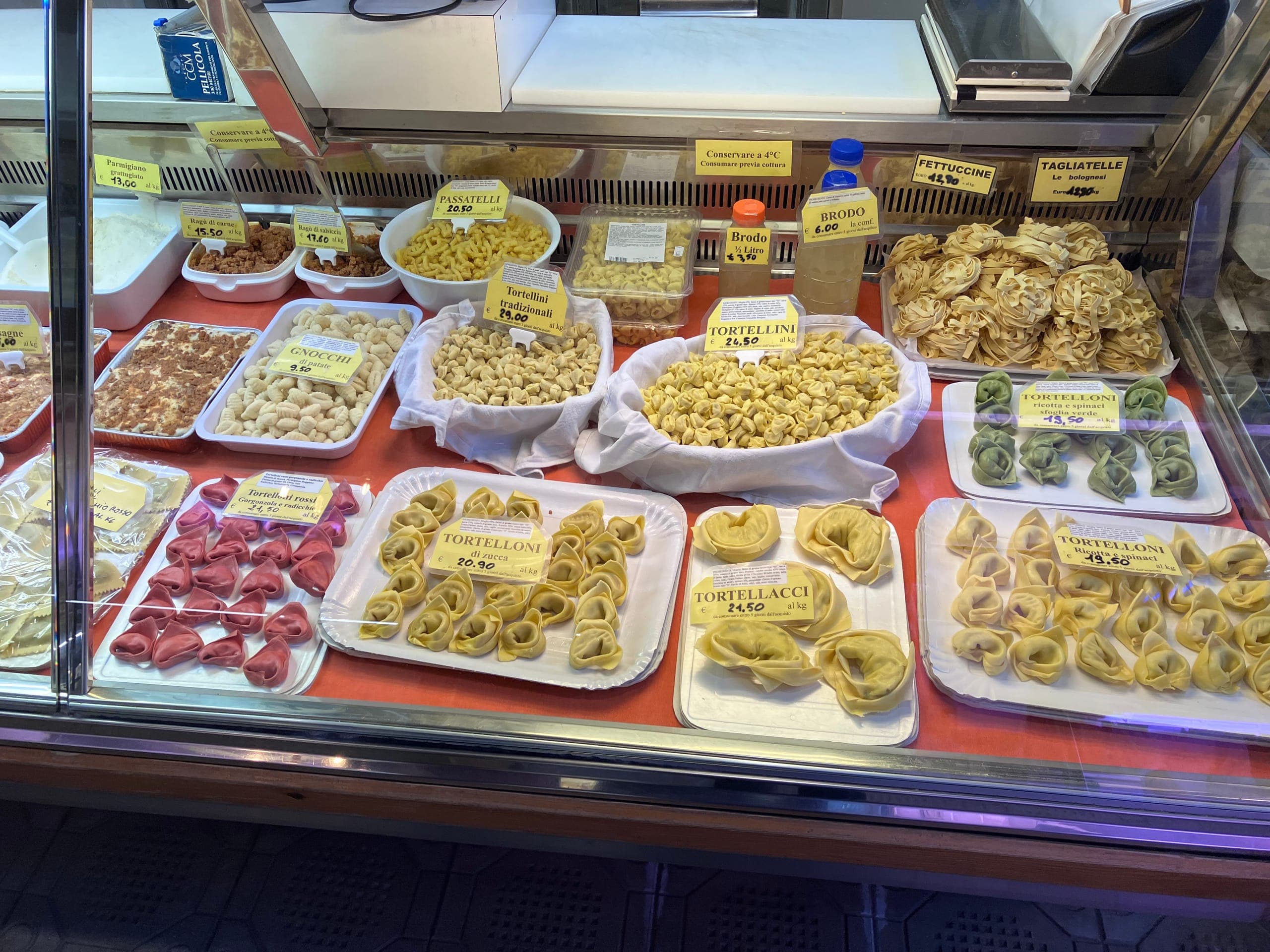
The Emilian tortellino has a legal address: the filling recipe was deposited at the Bologna Chamber of Commerce on 7 December 1974 by the Confraternita del Tortellino with the Accademia Italiana della Cucina: pork loin, prosciutto crudo, mortadella di Bologna, Parmigiano Reggiano, egg and nutmeg, in a sheet rolled to six tenths of a millimetre.
Bologna and Modena have argued over who invented it for as long as anyone can remember. What both agree on is the serving: in capon broth, clear, nothing else in the bowl. Cream is not a variant, it is a different dish. A capon is a cockerel castrated young and raised slowly, and it gives the broth a depth chicken does not; the boiled bird then reappears as the second course, so one animal makes two dishes.
What comes after the pasta
In the north, boiled meat. Piedmont's gran bollito misto is built on a rule of seven: seven cuts of beef, seven extras including tongue, cotechino and trotter, and seven sauces. Emilia does a quieter version.
In Naples, the opposite of Christmas Eve. After a fish dinner comes a meat lunch, centred on minestra maritata: bitter greens simmered with pork, hen and beef. The name means "married soup", and the marriage is between the greens and the meat — which is where the American dish gets its name wrong. Italian wedding soup is a mistranslation, the meatballs were added on the far side of the Atlantic, and it is not served at weddings.
In the south and the islands, roasting. Lamb with potatoes in Sicily, lamb alla leccese with turnip tops in Puglia, suckling pig on a spit in Sardinia.
Zampone and cotechino: the Modena part, and the New Year part
These two are ours, and they close the year rather than opening it. Zampone Modena and Cotechino Modena were both registered as PGI on 18 March 1999, on the same day. It is PGI, not PDO, a distinction almost never got right abroad.
The mixture is close to identical in both: coarsely worked pork muscle, fat and rind, salt and pepper, with permitted aromatics from Lambrusco to mace and clove. The difference is the casing: cotechino goes into a normal sausage skin, zampone into the pig's hollowed-out front trotter, which is why it arrives shaped like a foot and some guests need a moment.
Two things even Italian food writing muddles. First, the protected zone is far wider than Modena: the whole of Emilia-Romagna, eleven Lombard provinces from Milan to Mantua, plus Verona and Rovigo. "Modena" names the tradition, not the boundary. Second, the origin story is folklore. Local tradition has zampone invented during the papal siege of Mirandola in the winter of 1510-11, the besieged stuffing their pork into a trotter rather than surrender it. The siege is documented history; the zampone's part in it is not documented at all, and the story survives on repetition rather than evidence.
Both are eaten on 31 December with lentils, for reasons of arithmetic rather than taste: a lentil looks like a coin, so a plateful means money in the coming year. They go on the table just after midnight, one of very few Italian food customs kept at the same hour across the whole country.
Panettone against pandoro, settled by law
The one national argument, and a rare food question in Italy with an actual legal answer. A ministerial decree of 22 July 2005 defines both, with minimums a product must hit to use the name:
| Panettone (Milan) | Pandoro (Verona) | |
|---|---|---|
| Shape | Round base, cracked domed top | Truncated cone, eight-pointed star in section |
| Leavening | Natural sourdough, required | Natural sourdough, required |
| Butter | at least 16% | at least 20% |
| Egg yolk | at least 4% | at least 4% |
| Raisins and candied peel | at least 20% | none |
| Documented origin | None. Legends only | Melegatti patent filed 14 October 1894 |
Pandoro has a birth certificate: the Verona pastry maker Domenico Melegatti filed his patent on 14 October 1894. Panettone has none — only stories, the best known being the fifteenth-century kitchen boy Toni who supposedly rescued a ducal banquet, giving pan de Toni. Good story, not history: the oldest hard trace is a 1599 expense book at the Collegio Borromeo in Pavia, recording large sweet breads bought for Christmas.
More usefully: the panettone you picture is about a century old, not five. The tall, soft, domed version dates from 1919, when Angelo Motta began baking the dough inside a paper collar in Milan, letting it climb vertically. Before that it was low and wide. And the scoreboard has turned: a 2025 AstraRicerche survey for Unione Italiana Food put pandoro ahead, 52.6% to 47.4%, with over 33 million pieces sold in December alone — around 70% of the annual total.
The sweets that are not panettone
- Torrone, Cremona — almonds, honey and egg white. The founding story places it at the Sforza-Visconti wedding of 25 October 1441, shaped like the Torrazzo, the city's bell tower. Treat that as tradition rather than record: the first certain mention of torrone in Cremona is a municipal purchase of 1543, a century later.
- Panforte di Siena, PGI since 21 May 2013 and made only in that province — a dense disc of nuts, candied citrus, honey and spice, white under icing sugar or black under a spice crust.
- Struffoli, Naples — fried dough balls in honey. Cartellate, Puglia — ribbons of pastry soaked in vincotto.
- Certosino, Bologna — a dark cake of candied fruit, chocolate, honey and pine nuts. Pampapato di Ferrara, PGI since 2015 — a spiced dome under dark chocolate. Spongata, western Emilia — shortcrust filled with honey, almonds and candied peel.
Modena has no canonical Christmas cake, and we may as well say so. Torta Barozzi and bensone are ours and they are good, but they belong to the whole year, and we will not dress them as something they are not. Here the Christmas sweet is usually somebody else's, and nobody minds.
What Americans think is Italian Christmas food, and is not
The Italian-American table is a real cuisine with its own history. It is simply a different one, and knowing which is which saves you ordering things here that do not exist.
- Spaghetti and meatballs. Italian-American: in Italy meatballs are their own dish, eaten separately, and never a Christmas food. Chicken parmigiana was invented by immigrants in North America; Italy has parmigiana di melanzane, made with aubergine, and it is a summer dish. Garlic bread is a twentieth-century American creation.
- Rainbow cookies. The tricolour layered biscuits on every Italian-American Christmas tray came from bakeries in New York around 1900. There is no direct equivalent in Italy; the food historian Mary Taylor Simeti has suggested they descend from Sicilian gelato di campagna.
- Roast turkey, glazed ham, eggnog, gingerbread houses, cookies for Santa. None belong to an Italian Christmas. Nor does dinner on the evening of the 25th.
- Cannoli and tiramisù. Genuinely Italian, and neither is a Christmas dessert — they are served all year.
The one item that survives the audit intact is panettone, which really is the national Christmas cake.
Can you actually eat any of this in a restaurant?
This is the question that decides whether a December trip works. The short version: the meal described above is a home meal, and the restaurant version is a different product with different rules.
The numbers, from FIPE-Confcommercio on Christmas 2025: 5.5 million people ate out on 25 December, in just over 93,000 restaurants — 69.6% of those in business, meaning roughly three in ten were closed. Average spend was €82 a head including drinks, and 72.4% served a single fixed menu: no à la carte, no choosing. 75% of the customers were local residents, barely 5% foreign visitors. This is a day Italians spend among themselves.
- Book weeks ahead, not days, and expect one sitting, at lunch, around half past twelve. Many kitchens do not open that evening at all.
- Expect a set price and a set menu. In Emilia: tortellini in broth, then bollito or a roast, then cake. It will be good. It will not be flexible.
- Do not plan on shopping. Most supermarket chains close entirely on the 25th, several stay closed on the 26th, and covered markets are shut on Christmas Day.
Which leads to the argument we make to our own guests: in a food city, rent a kitchen. On 23 and 24 December the Albinelli covered market runs extended hours and is at its busiest of the year — fresh tortellini by weight, capon for the broth, zampone tied and ready, Parmigiano cut from a named and dated wheel. You buy what your neighbours are buying, and cook the meal rather than watch a set menu arrive. Our restaurant guide covers ordinary weeks; December is stricter.
What is not worth planning a trip around
- Do not fly to Italy for the Christmas markets. The big alpine ones are in Alto Adige, and as a market destination Italy does not compete with Vienna or Nuremberg. Our regional guide says the same at length; Christmas in Modena covers this city's version.
- 25 December is not a sightseeing day. Museums close, shops close, the country is indoors at a family table. Plan it as a day of eating, or a rest day. And do not expect a white Christmas on the plain: it rarely snows here, it just turns damp and grey.
- December is hard on restrictive diets. The repertoire is pork, egg pasta, broth and capon, a fixed menu rarely bends, and only 3% of Italian households eat a vegetarian Christmas. Say what you need in writing when you book, or self-cater.
- Do not expect to be included in a family lunch. Italians eat Christmas at home with relatives; the warmth you have read about is real and private, and the public version is a set menu. Knowing that in advance is the difference between a good trip and a disappointed one.
- If you only want the food, come in January. Bollito, cotechino and tortellini in broth run all winter, the cities are empty, and nothing costs holiday prices.
Where to stay, if this is the trip you are taking
We are hosts here, so treat this as interested rather than neutral. We are one possible base among many, and the case for this one is narrow: position on the railway line, and price. Regional trains reach Bologna in 18 to 30 minutes and Parma in about half an hour, several times an hour, no booking needed, and rooms cost noticeably less than Bologna over the holidays.
We rent four apartments in the historic centre, booked directly with us with no platform commission. For a Christmas where the meal happens in the apartment, the one that fits is the penthouse on Piazza Mazzini: it sleeps up to eight — the average Italian Christmas table, almost exactly — it has a proper kitchen, and it is minutes from the covered market. It sits inside the limited traffic zone, so if you drive we arrange the permit at €10 a day, and there is no lift, which is worth knowing first. All four are on the apartments page; where to stay in Modena explains the difference between those inside the old town and the two on the boulevards, where you park at the door and need no permit.
Read before you travel
For the month as a whole, Italy in December and Christmas markets in Italy; the Christmas market weekend break is the short version. On the food, the flavours of Modena covers the year-round repertoire, the Emilia-Romagna food trip lays out the regional route, and balsamic vinegar and visiting a Parmigiano dairy fill the mornings. For mechanics, getting to Modena, the ZTL and parking.
Frequently asked questions
What do Italians actually eat on Christmas Day? Lunch, not dinner, opening with filled pasta in broth: tortellini or cappelletti in capon broth in Emilia-Romagna and the Marche, agnolotti in Piedmont, baked pasta in much of the south. Then boiled or roasted meat — bollito misto in the north, lamb in Sicily and Puglia, minestra maritata in Naples — and panettone or pandoro to finish.
Is the Feast of the Seven Fishes a real Italian tradition? The meal is real; the name and the number are not. In Italy 24 December is simply la Vigilia, and a 2025 Coldiretti/Ixè survey found fish on 77% of tables that evening. But no Italian family counts to seven, and the earliest known print reference is a 1983 Philadelphia Inquirer article. Seven- and thirteen-course fish dinners are documented in Calabria: the roots are Italian, the label was made in America.
What is the difference between zampone and cotechino? The mixture is nearly identical — coarsely worked pork muscle, fat and rind, salted and spiced. The difference is the casing: cotechino goes into a conventional sausage skin, zampone into the hollowed-out front trotter of the pig. Both were registered as PGI, under the names Zampone Modena and Cotechino Modena, on 18 March 1999.
Can I eat Christmas lunch in a restaurant in Italy? Yes, but not the meal you are imagining. At Christmas 2025 FIPE-Confcommercio counted 5.5 million people eating out on 25 December in just over 93,000 restaurants — 69.6% of those in business, so roughly three in ten were shut. Of those open, 72.4% served one fixed menu at an average of €82 a head, and 75% of the customers were local residents.
Panettone or pandoro — which is more traditional? Panettone has no documented birth date, only legends, and the tall domed shape dates from 1919, when Angelo Motta began baking it in a paper collar. Pandoro has a precise origin: Domenico Melegatti filed his patent on 14 October 1894. Italian law defines both — panettone needs at least 16% butter and 20% raisins and candied peel, pandoro at least 20% butter and neither.
Are supermarkets and shops open in Italy on Christmas Day? Assume not. Most Italian supermarket chains close completely on 25 December, several stay shut on the 26th, and those that reopen run short holiday hours. Covered food markets close on Christmas Day too. If you are self-catering, shop on 23 or 24 December, when the markets keep long hours, and check the individual store.
Which Italian Christmas foods are not really Italian? Spaghetti and meatballs, chicken parmigiana, garlic bread and rainbow cookies are Italian-American inventions you will not find here at any time of year. Italian wedding soup is a mistranslation of minestra maritata, where "married" describes the pairing of greens and pork. Roast turkey, eggnog and gingerbread houses have no place in an Italian Christmas. Cannoli and tiramisù are Italian, but they are year-round desserts.
Why do Italians eat lentils at New Year? For their shape. A lentil looks like a coin, so a plateful stands for money coming in — a symbolism traced to the Roman habit of exchanging legumes as good-luck gifts. They go on the table just after midnight on 31 December, alongside cotechino or zampone, because pork carries its own meaning of abundance.
Frequent questions
What readers ask us most.
What do Italians actually eat on Christmas Day?
Lunch, not dinner, opening with filled pasta in broth: tortellini or cappelletti in capon broth in Emilia-Romagna and the Marche, agnolotti in Piedmont, baked pasta in much of the south. Then boiled or roasted meat — bollito misto in the north, lamb in Sicily and Puglia, minestra maritata in Naples — and panettone or pandoro to finish.
Is the Feast of the Seven Fishes a real Italian tradition?
The meal is real; the name and the number are not. In Italy 24 December is simply la Vigilia, and a 2025 Coldiretti/Ixè survey found fish on 77% of tables that evening. But no Italian family counts to seven, and the earliest known print reference is a 1983 Philadelphia Inquirer article. Seven- and thirteen-course fish dinners are documented in Calabria: the roots are Italian, the label was made in America.
What is the difference between zampone and cotechino?
The mixture is nearly identical — coarsely worked pork muscle, fat and rind, salted and spiced. The difference is the casing: cotechino goes into a conventional sausage skin, zampone into the hollowed-out front trotter of the pig. Both were registered as PGI, under the names Zampone Modena and Cotechino Modena, on 18 March 1999.
Can I eat Christmas lunch in a restaurant in Italy?
Yes, but not the meal you are imagining. At Christmas 2025 FIPE-Confcommercio counted 5.5 million people eating out on 25 December in just over 93,000 restaurants — 69.6% of those in business, so roughly three in ten were shut. Of those open, 72.4% served one fixed menu at an average of €82 a head, and 75% of the customers were local residents.
Panettone or pandoro — which is more traditional?
Panettone has no documented birth date, only legends, and the tall domed shape dates from 1919, when Angelo Motta began baking it in a paper collar. Pandoro has a precise origin: Domenico Melegatti filed his patent on 14 October 1894. Italian law defines both — panettone needs at least 16% butter and 20% raisins and candied peel, pandoro at least 20% butter and neither.
Are supermarkets and shops open in Italy on Christmas Day?
Assume not. Most Italian supermarket chains close completely on 25 December, several stay shut on the 26th, and those that reopen run short holiday hours. Covered food markets close on Christmas Day too. If you are self-catering, shop on 23 or 24 December, when the markets keep long hours, and check the individual store.
Which Italian Christmas foods are not really Italian?
Spaghetti and meatballs, chicken parmigiana, garlic bread and rainbow cookies are Italian-American inventions you will not find here at any time of year. Italian wedding soup is a mistranslation of minestra maritata, where "married" describes the pairing of greens and pork. Roast turkey, eggnog and gingerbread houses have no place in an Italian Christmas. Cannoli and tiramisù are Italian, but they are year-round desserts.
Why do Italians eat lentils at New Year?
For their shape. A lentil looks like a coin, so a plateful stands for money coming in — a symbolism traced to the Roman habit of exchanging legumes as good-luck gifts. They go on the table just after midnight on 31 December, alongside cotechino or zampone, because pork carries its own meaning of abundance.
Eat properly, then walk home.
Mercato Albinelli, the trattorias of the old town and the Lambrusco counters are all minutes from our apartments. After a dinner like that, not having to drive is half the pleasure.