Christmas Markets in Emilia-Romagna: Where to Go, and Where to Sleep
FNFrancesco NoliThe short answer
Emilia-Romagna is not the Christmas market region of Italy — that is Alto Adige, four hours north — but it has something the Alps do not: markets you reach in twenty minutes by train from one another, in cities that eat better than anywhere else in the country. Bologna has the oldest fair in Europe under the Servi portico, Ferrara a village in Piazza Trento Trieste, Comacchio nativity scenes under its bridges, and Modena a Tyrolean market in a UNESCO square. Base yourself in Modena or Parma rather than Bologna: rooms cost less and the trains run all day.
Bologna, Ferrara, Parma, Comacchio and Modena: which Christmas markets are worth the train, how to string them together, and which town to base yourself in.
Emilia-Romagna is not where you come for Christmas markets. That is Alto Adige — Bolzano, Merano, Trento — where the tradition is Austrian, the mountains are behind the stalls, and the whole thing is built at a scale this region never attempts.
What Emilia-Romagna has instead is unusual in a different way: five markets within an hour of each other by train, in cities that happen to be the best place to eat in Italy. You can see a market in the morning, be in another city by noon, and have the sort of lunch that makes people rearrange their holidays. Nobody comes here for the chalets. They come for the chalets and the tortellini, and that combination does not exist in the Alps.
This guide covers what is in each city, how to string them together, where to sleep, and — because we are hosts here rather than a tourist board — whether the trip is worth taking at all.
The markets, city by city
| City | What is there | From Modena by train |
|---|---|---|
| Bologna | Fiera di Santa Lucia under the Servi portico, going back to the late sixteenth century; the Altabella fair beside the cathedral; a French village in Piazza Minghetti | 18-30 minutes |
| Modena | Modena Christmas Village, Tyrolean chalets across three squares, with light projections on the UNESCO cathedral | — |
| Parma | Markets in the Trentino style, with a programme of themed concerts | about 30 minutes |
| Ferrara | The Christmas Village in Piazza Trento Trieste, with local artisans | about an hour, change at Bologna |
| Comacchio | Nativity scenes set under the canal bridges, including the Trepponti | a full day, car advisable |
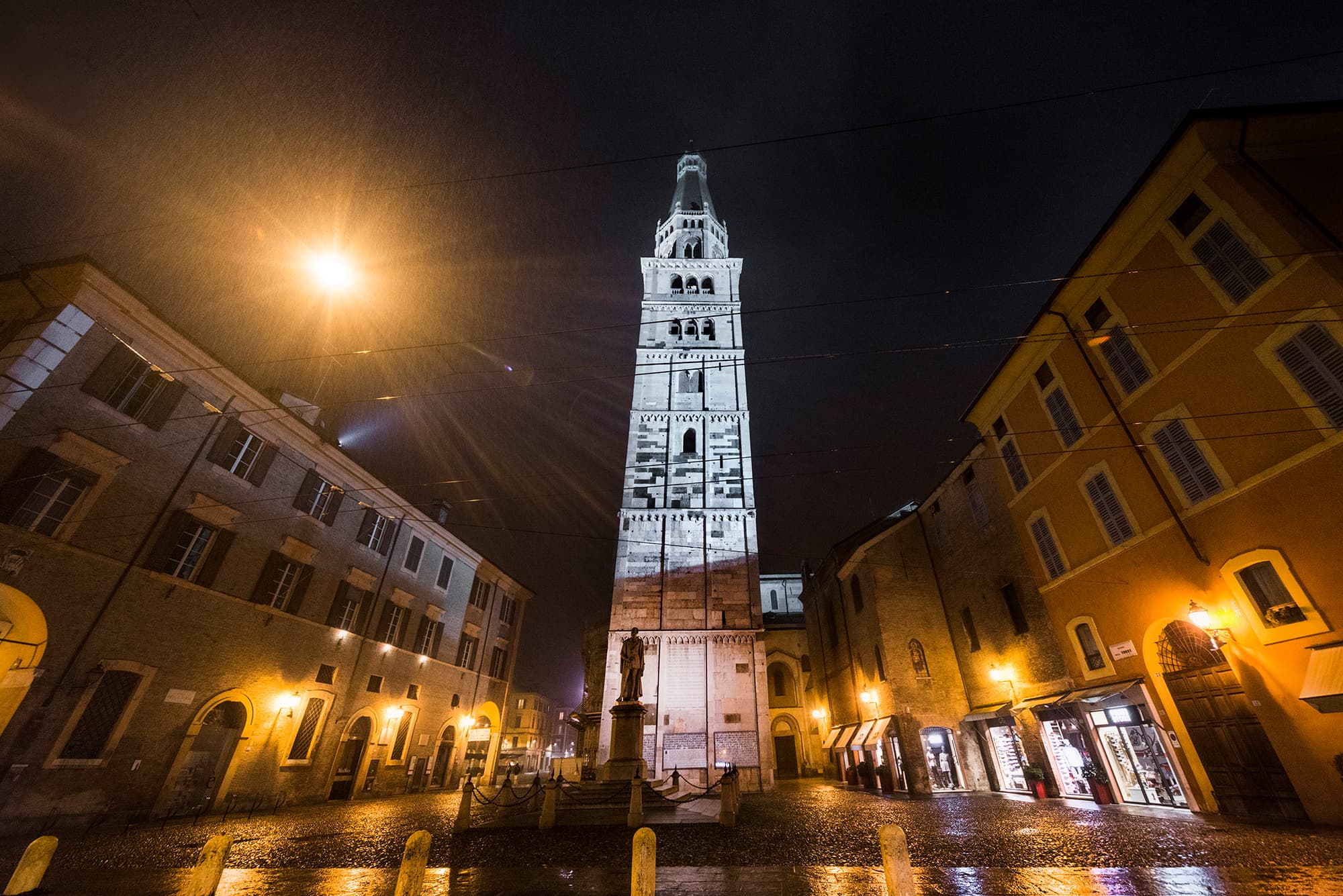
Bologna is the biggest, and the Santa Lucia fair is the one with real history: it traces back to the late sixteenth century and has been held under the same Gothic portico — itself part of the UNESCO-listed Bologna porticoes — for generations. It is the oldest Christmas fair in Bologna and Emilia-Romagna, though not, as you will sometimes read, in Europe: Dresden's Striezelmarkt goes back to 1434. Modena is the prettiest setting — the chalets stand in a square that has been UNESCO-listed since 1997, and every evening the cathedral facade is lit with projections. Comacchio is the odd one, and the most memorable if you have the time: not a market so much as nativity scenes along the canals of a lagoon town that looks like a smaller Venice.
When they open
Most of the region opens in the second half of November and runs to 6 January. In the 2025 season Modena ran from 21 November, Ferrara from 22 November, and Bologna's Altabella fair from 21 November, all closing at Epiphany.
Dates for the coming season are published by each city between October and November. This page gives you the pattern, not a promise: check the city's own site before booking flights around a specific weekend.
The plan that works: base yourself away from Bologna
Most visitors book Bologna because it is the biggest name and has the airport. In December that is the expensive choice.
Rooms in Bologna cost considerably more through the holidays, the centre is busy every weekend, and the restaurants that matter are booked out. Meanwhile Modena and Parma sit on the same railway line — the Milan-Bologna corridor, with trains every few minutes — and cost less for the same distance from everything.
The itinerary we suggest to guests:
Day one. The market in your base town in the late afternoon, when the lights come on. In Modena that means the three squares and the projections on the cathedral; dinner in a trattoria, booked ahead.
Day two. Train to Bologna in the morning, the Santa Lucia fair and the Altabella one, lunch under the porticoes, an afternoon walking the centre. Back for dinner where the tables are easier.
Day three, if you have it. Ferrara or Parma. Ferrara is the quieter, more surprising town; Parma is the food capital with a market on top.
Three days, three markets, no car, and one hotel bill at Modena prices. Our guide to getting to Modena has the train detail, including the shuttle from Bologna airport.
What each city is really for
Markets are the excuse. What separates these cities is what you eat and what you see between one stall and the next.
Bologna is porticoes, the two towers, and the food quarter of the Quadrilatero. In December it is the liveliest place in the region and the hardest to book.
Modena is smaller and quieter: a Romanesque cathedral that is one of the finest in Europe, a covered market where locals still shop, and — the reason many people come at all — traditional balsamic vinegar, which is made in the countryside around the city and can be visited even in winter. Our balsamic guide explains how a visit works.
Parma is prosciutto, Parmigiano and a baptistery in pink Verona marble. If you are doing a food trip rather than a market trip, it belongs on the list.
Ferrara is a Renaissance city with a moated castle in the middle of it, flat and made for bicycles, and much emptier than the others in December.
Comacchio is the outlier: canals, bridges, eel, and in December the nativity scenes underneath the bridges. It needs a car and most of a day, and it is the one people remember.
Getting here from the UK and the US
The region's airport is Bologna Guglielmo Marconi (BLQ), and it is the only one that makes sense: it sits in the middle of everything in this guide. From the UK there are direct flights from several airports; from North America you will connect, usually through a European hub.
From the airport into the region:
- To Bologna city: the Marconi Express monorail, 7 minutes 30 to Bologna Centrale, €12.80.
- To Modena: the Aerbus coach, about 50 minutes, €15, no changes and luggage carried free — or the monorail plus a regional train, which costs slightly more and adds a change.
- To Parma or Ferrara: train from Bologna Centrale, both under an hour.
The full comparison, including the last departures at night, is in getting to Modena.
Milan works too if the fare is much better: Milan Centrale to Bologna is an hour on a high-speed train, and Milan has its own market season if you want to add a city.
Two things British and American visitors get wrong
The opening hours. Shops and markets here close for a long lunch in smaller towns, and the covered food markets shut mid-afternoon — Modena's Albinelli closes at 3pm and does not open on Sundays. A plan built around "we'll do the market after lunch" fails more often than it works.
Dinner time. Kitchens open around 7:30 or 8pm and are done by 10 or 10:30. Arriving at 6pm hungry, as you might in London or New York, means a closed door and an aperitivo instead. In December, when you have been outside in the damp since mid-afternoon, that gap catches people out badly — plan an early aperitivo with something to eat, then dinner properly.
Neither is a complaint about the region: it is how the day is shaped here, and once you know it, December becomes easy rather than frustrating.
What it costs
| Regional train between these cities | From about €5, no booking needed |
| Lunch in a trattoria | €25-35 a head, three courses and a glass |
| Mulled wine at a market stall | A few euros |
| A room in Modena in December | Noticeably less than the same room in Bologna |
| Entry to any of these markets | Free |
Cards work almost everywhere; the oldest market stalls and the smallest trattorie still prefer cash.
The food, which is the actual argument
December is when Emilian cooking makes most sense, because it is winter cooking that spent the rest of the year waiting for the cold.
Tortellini in capon broth is the Christmas dish in both Modena and Bologna — small filled pasta in clear broth, not in cream, and it is the centre of the meal rather than a starter. Bollito misto, a trolley of boiled meats carved at your table, belongs to the same season. Zampone and cotechino, stuffed pork served with lentils, are what the region eats at New Year, and both come from Modena with protected status.
Book ahead: in December even lunch fills up, and on 31 December restaurants serve a set menu that sells out weeks in advance. Our restaurant guide has the detail on which places serve lunch only, which catches visitors out all year and doubly so in December.
What to buy, and what will get home
Christmas markets everywhere sell much the same crafts. What makes this region different is what you can buy a hundred metres away, in the food shops and covered markets, and most of it travels better than you would think.
- Traditional Balsamic Vinegar of Modena PDO — the sealed 100 ml bottle, aged at least twelve years. It keeps indefinitely and fits the cabin baggage liquid limit exactly, so it flies home in your hand luggage. It is expensive and it should be: our balsamic guide explains how to tell it from the cheap kind.
- Parmigiano Reggiano, bought vacuum-packed at a market stall or at a dairy shop, where they will tell you the exact production date. Hard cheese is admissible into both the UK and the US, but must be declared on arrival in the States.
- Prosciutto di Parma — the same rule applies, and the same warning: declare it.
- Nocino, the green walnut liqueur made across the Modena province, and Lambrusco, which bears no resemblance to the sweet supermarket version sold abroad.
The place to buy all of it is a covered market in the morning, not a Christmas stall in the evening. In Modena that means the Albinelli; in Bologna, the Quadrilatero.
A weekend that does not involve markets at all
Worth saying, because December here has a second argument. The cities are quiet, the museums are empty, the restaurants that are impossible to book in May have tables on a Tuesday in December, and the balsamic producers keep receiving visitors through the winter — in a loft that smells different in the cold than it does in August.
If the markets turn out to be smaller than you hoped, you have not wasted the trip: you are in the middle of the best eating in Italy in the season built for it, in cities where nobody is queueing. That is the honest case for coming here in December, and it does not depend on a single wooden chalet.
When to come, and when not to
- Weekdays are the difference between walking and shuffling. If you have any flexibility, use it here.
- The 8 December holiday weekend is the busiest of the season across the whole region. Avoid it, or accept crowds and book everything.
- Between Christmas and Epiphany the markets are still up and the crowds have gone. It is the window we recommend, and the one nobody books.
- January and February are the quietest months in this province by a distance — worth knowing if you want the cities to yourself and do not need the markets at all.
What not to expect
- This is not Alto Adige. The markets here are municipal-scale, not the multi-week alpine institutions with mountains behind them. If the market is the whole point of the trip, go north.
- It is not a snow destination. The Po plain gets fog and damp cold, rarely snow. Dress for humidity rather than for a postcard.
- The famous names are further away. If your list includes Verona, Trento or Bolzano, those are separate trips, not day trips from here.
- Sunday closures still apply. Covered markets shut on Sundays, and plenty of trattorie take the day off — market season does not change that.
- Comacchio needs a car, and in bad weather it is a long way to go for nativity scenes.
Where to stay
We rent four apartments in Modena's historic centre, which is why we think Modena works as a base — but the argument stands on its own: it is on the main line, rooms cost less than in Bologna, and everything in this guide is inside an hour.
You book directly with us, with no platform commission. Two apartments are inside the limited traffic zone, minutes from the market squares: the penthouse on Piazza Mazzini, which sleeps up to eight and suits families over the holidays, and the apartment on via De' Correggi. Two are on the boulevards with parking at the door, useful if you are driving out to Comacchio or the hills. All four are on the apartments page.
Message us before you arrive and we will tell you which restaurants still have space on your dates — in December that is worth more than any other advice we can give.
Read next
Christmas in Modena has the detail on this city's market: squares, hours, the Santa Claus village and New Year. For getting around, getting to Modena; for the ZTL and parking, Modena's ZTL. And if the food is the real reason you are coming, the Emilia-Romagna food trip sets out the same region without the chalets.
Frequently asked questions
Does Emilia-Romagna have good Christmas markets? It has several good ones and no great one. Bologna's Fiera di Santa Lucia dates to the late sixteenth century and is the oldest Christmas fair in Bologna and Emilia-Romagna, Ferrara and Modena run proper markets, and Comacchio sets nativity scenes under its canal bridges. If you want the biggest markets in Italy, those are in Alto Adige — Bolzano, Merano, Trento — about four hours north.
Which is the best Christmas market in Emilia-Romagna? Bologna, on size and history: the Santa Lucia fair has run under the portico of the Servi for centuries and the city adds a French village and the Altabella fair. Modena's is smaller but sits in a UNESCO square with light projections on the cathedral, and it is the better place to sleep and eat.
Where should I stay to visit several markets? Modena or Parma rather than Bologna. Both sit on the same railway line, both are cheaper in December, and from either you reach Bologna in half an hour and Ferrara or Parma in about an hour. Bologna is the busiest and most expensive base in the region during the holidays.
When do Christmas markets open in Emilia-Romagna? Most open in the second half of November and run to 6 January. In the 2025 edition Modena ran 21 November to 6 January, Ferrara from 22 November, and Bologna's Altabella fair from 21 November. Exact dates for the coming season are published by each city in October and November.
Can I visit these markets without a car? Yes, and it is the better way. Bologna, Modena, Parma, Reggio Emilia and Ferrara are all on regional train lines, with departures every few minutes on the Milan-Bologna corridor and no booking needed. Only Comacchio and the Apennine villages really need a car.
How many days do you need? Two full days cover two cities comfortably — one market each, with time to eat properly, which in this region is the point. Three days let you add Ferrara or Parma. Anything shorter turns into a rush between stations.
Is it worth flying to Italy just for these markets? No, and we would rather say it plainly. As a Christmas-market destination Emilia-Romagna does not compete with Alto Adige or with Vienna and Nuremberg. It is worth it if you want markets plus the best food in Italy, or if you are already coming for something else and December is when you can travel.
What is the food to look for in December? Tortellini in capon broth, which is the Christmas dish in Modena and Bologna; bollito misto, the trolley of boiled meats; and zampone or cotechino with lentils at New Year. All three are winter dishes that appear on menus only in the cold months.
Frequent questions
What readers ask us most.
Does Emilia-Romagna have good Christmas markets?
It has several good ones and no great one. Bologna's Fiera di Santa Lucia dates to the late sixteenth century and is the oldest Christmas fair in Bologna and Emilia-Romagna, Ferrara and Modena run proper markets, and Comacchio sets nativity scenes under its canal bridges. If you want the biggest markets in Italy, those are in Alto Adige — Bolzano, Merano, Trento — about four hours north.
Which is the best Christmas market in Emilia-Romagna?
Bologna, on size and history: the Santa Lucia fair has run under the portico of the Servi for centuries and the city adds a French village and the Altabella fair. Modena's is smaller but sits in a UNESCO square with light projections on the cathedral, and it is the better place to sleep and eat.
Where should I stay to visit several markets?
Modena or Parma rather than Bologna. Both sit on the same railway line, both are cheaper in December, and from either you reach Bologna in half an hour and Ferrara or Parma in about an hour. Bologna is the busiest and most expensive base in the region during the holidays.
When do Christmas markets open in Emilia-Romagna?
Most open in the second half of November and run to 6 January. In the 2025 edition Modena ran 21 November to 6 January, Ferrara from 22 November, and Bologna's Altabella fair from 21 November. Exact dates for the coming season are published by each city in October and November.
Can I visit these markets without a car?
Yes, and it is the better way. Bologna, Modena, Parma, Reggio Emilia and Ferrara are all on regional train lines, with departures every few minutes on the Milan-Bologna corridor and no booking needed. Only Comacchio and the Apennine villages really need a car.
How many days do you need?
Two full days cover two cities comfortably — one market each, with time to eat properly, which in this region is the point. Three days let you add Ferrara or Parma. Anything shorter turns into a rush between stations.
Is it worth flying to Italy just for these markets?
No, and we would rather say it plainly. As a Christmas-market destination Emilia-Romagna does not compete with Alto Adige or with Vienna and Nuremberg. It is worth it if you want markets plus the best food in Italy, or if you are already coming for something else and December is when you can travel.
What is the food to look for in December?
Tortellini in capon broth, which is the Christmas dish in Modena and Bologna; bollito misto, the trolley of boiled meats; and zampone or cotechino with lentils at New Year. All three are winter dishes that appear on menus only in the cold months.
An itinerary is better without transfers.
With your base in the historic centre you can walk this whole route and drop home whenever you like: a break in the afternoon, then back out for an aperitivo.