Car Museums in Italy: which are worth it, and where to base yourself
FNFrancesco NoliThe short answer
Italy's car museums cluster rather than spread. Five of the most important — the two Ferrari museums, Lamborghini, Pagani and Ducati — sit within 40 kilometres of Modena, along with the Maserati plant tour and two private collections, which makes one base enough for three or four days. The rest are scattered across the north: the national museum in Turin with over 200 cars from 80 marques, Alfa Romeo at Arese near Milan, the Nicolis collection near Verona and the Mille Miglia museum in Brescia. The detail that decides most itineraries is which factories actually open: Lamborghini, Pagani, Maserati and Ducati let visitors in, and Ferrari does not.
Italy's car museums are not spread evenly. Five of the best sit within 40 km of one city, and only one famous marque refuses to show you its factory.
Most lists of Italian car museums have the same problem: they give you ten places in ten cities and leave you to work out that visiting them all would take a fortnight and several hundred kilometres of motorway.
The more useful fact is that Italy's car museums cluster rather than spread. Five of the most important sit inside a forty-kilometre circle, and the rest are scattered across the north one to a city. Which means the real question is not which museums but which base — and that answer is easier than it looks.
There is also a detail that decides more itineraries than any other, and almost nobody puts it up front: the most famous marque of all is the one that will not show you its factory.
The cluster: five museums inside forty kilometres
Everything here is within an hour of Modena, and three of the five are within twenty minutes.
| Museum | Distance from Modena | Adult ticket | Factory visit |
|---|---|---|---|
| Enzo Ferrari Museum, Modena | in the city, on foot | €27 / €32 | no |
| Pagani, San Cesario sul Panaro | 17 km | €18 (museum only) | yes, €60 guided |
| Ferrari Museum, Maranello | 18 km | €27 / €32 | no |
| Lamborghini, Sant'Agata Bolognese | 30 km | €18 | yes |
| Ducati, Bologna Borgo Panigale | 40 km | €18 | yes |
Add to those a Maserati plant tour inside Modena itself, plus two private collections in the city, and you have more serious automotive history in one province than most countries manage nationally.
The Ferrari pricing detail worth knowing: adult admission is €27 from September to May and €32 from June to August. High season is three months, not five, which contradicts a large number of English-language pages — May and September cost the same as November. And there is a discount that is on Ferrari's own ticket page and rarely quoted: arrive on an Emilia-Romagna regional train, show the used ticket, and one museum is €20 in any season, both €32. Coming over from Bologna for the day, you already hold it.
Full detail on the two Ferrari museums is in Enzo Ferrari Museum in Modena and Ferrari Museum Maranello.
The thing nobody puts first: which factories actually open
This is the table that changes plans.
| Marque | Can you go into the factory? |
|---|---|
| Lamborghini | Yes — guided tours of the production lines, leaving from the museum |
| Pagani | Yes — the Atelier, on a separate guided visit |
| Maserati | Yes — a tour of the Modena plant |
| Ducati | Yes — the Borgo Panigale Experience |
| Ferrari | No — plant visits are for clients and F1 sponsors only |
What Ferrari sells as a factory tour is a 45-minute panoramic ride on an electric bus, around the company site and the Fiorano test track, seated the whole way. It costs €25 on top of museum admission. It is a pleasant three quarters of an hour. It is not a factory tour.
So: four chances out of five to watch a supercar being built, and the famous one is not among them. People who fly in specifically to see Ferrari being made go home disappointed, every week, and it is entirely avoidable information.
The two production visits are also different in character. Lamborghini is a modern plant — automated guided vehicles moving parts along the line, collaborative robots working beside people. Pagani is the opposite extreme: a company building tiny numbers of cars, working carbon fibre by hand, in what feels more like a laboratory than a factory. If you only do one, pick by which of those two images appeals.
The rest of Italy, one museum per city
Outside Emilia the museums are excellent and far apart.
Turin — the national collection
The national automobile museum is the biggest in the country and the oldest of the group, founded in 1933. It holds over 200 original cars from 80 marques, from late nineteenth-century steam carriages through the design of the 1950s to prototypes: Fiat, Alfa Romeo, Lancia, Ferrari, Bugatti, Rolls-Royce.
Admission is €18 for adults, €15 reduced for over-65s and visitors aged 18 to 25, and €8 for ages 6 to 17; free under 5. Hours are 10:00-14:00 on Mondays and 10:00-19:00 Tuesday to Sunday. A renovation of the display route is under way and the museum stays open during the work.
If your interest is the history of the automobile rather than any single marque, this is the one that goes deepest.
Milan — Alfa Romeo at Arese
The historic Alfa Romeo museum at Arese, just outside Milan, reopened with a completely renovated display. Tickets are modest — a reduced rate of €12 is listed, with €5 for ages 6 to 18 and free entry for under-5s and disabled visitors with a companion — but the full adult price is worth confirming on the official page before you go, because the published rates are inconsistent across sources.
It also opens on a number of public holidays through the year, which is unusual in this category.
Verona — the Nicolis collection
The Museo Nicolis at Villafranca di Verona, viale Postumia 71, is the outlier of the group and the one that surprises people. It holds over 200 vintage cars alongside motorcycles, bicycles, aircraft, musical instruments and cameras — a private collection assembled with a logic that is not purely automotive.
Open Tuesday to Sunday, 10:00-18:00.
Brescia — the Mille Miglia
The Museo Mille Miglia tells the story of the road race that ran from Brescia to Rome and back, and it is the cheapest ticket of the lot: €10 full, €8 for over-65s and groups over 20, €4 for ages 11 to 16 and free under 10. Open daily, 10:00-18:00.
For anyone who cares about racing history rather than showroom cars, it punches far above its price.
How to plan it: two, three or four days
Two days, one base. The two Ferrari museums on the combined pass, which runs on a 48-hour window and is designed to be split across days. Day one Maranello with the panoramic tour; day two Modena on foot. Nothing else needed.
Three days. Add either Lamborghini or Pagani, with the factory visit — this is the day that turns a museum trip into something you remember. Lamborghini is thirty kilometres north-east, Pagani seventeen south-east; both need a car.
Four days. Add Ducati at Bologna, which sits in a different direction from everything else and needs its own day. Two warnings on that one: it closes on Wednesdays, when every other motor museum in the area is open, and the station called Bologna Borgo Panigale, fourteen minutes' walk from the door, is on the Porrettana line and is not served by Modena–Bologna trains. You change at Bologna Centrale.
A week, moving around. Only if you genuinely want the whole history: Turin, Milan, Verona and Brescia are separate trips, each a couple of hours by train from the others, and stringing them together means a lot of railway for a moderate number of cars.
Do you need a car?
Partly, and it splits cleanly.
Reachable without a car: the Enzo Ferrari Museum in Modena, a seven-minute walk from the station. The Ferrari Museum at Maranello, on SETA bus 800, 27 to 31 minutes for €3.30 — with the warning that there are only six buses on a Sunday, and a gap of nearly five hours in the afternoon between returns. All of the Turin, Milan, Verona and Brescia museums, by train and local transport.
Not reachable without a car: Lamborghini at Sant'Agata and Pagani at San Cesario. We looked for a public connection we could recommend for a timed visit and did not find one. A taxi or a hire car is the answer, and if you are doing both in one trip the hire car pays for itself.
Ducati sits in between: doable by train with a change, awkward with a fixed factory-tour slot.
The full transport comparison for Maranello — bus, private shuttle, taxi and car, with the real timetables — is in our Italian guide to getting from Modena to Maranello.
What not to expect
- Not a Ferrari production line. Said again because it is the single most common disappointment in Italian car tourism.
- Not driving. None of these museums puts you behind a wheel. Supercar hire in Maranello is run by independent agencies, on public roads, with an instructor and normal speed limits.
- Not everything open on the same days. Ducati closes Wednesdays, Pagani closes on public holidays, Lamborghini has variable closures in mid-August and at Christmas, and the Ferrari museums close only on 25 December and 1 January. Assuming a uniform pattern is how people lose a day.
- Not one long opening day. Pagani shuts at 17:00, earlier than everyone else. From November to March the Ferrari museums stop admitting at 17:15.
- Not much around the smaller ones. Sant'Agata Bolognese and San Cesario sul Panaro are farming towns with a factory in them. Maranello is a working industrial town. Evenings happen in Modena or Bologna.
Why we would base in Modena
We are not neutral — we let apartments there — so here is the argument on its own terms, and the case where it does not hold.
The argument. Five museums within forty kilometres, three of them within twenty; a factory tour you can actually take; a public bus to Maranello and a walk to the Enzo Ferrari Museum; Bologna half an hour away by train with continuous service. Nowhere else in Italy puts that many marques inside one radius.
Where it does not hold. If Turin's national collection is the reason you are coming, base in Turin: it is a different trip. If you want Alfa Romeo and nothing else, base in Milan. And if you have one afternoon in northern Italy and a general curiosity about cars, Turin gives you eighty marques under one roof, which is better value for a single visit than any single-marque museum.
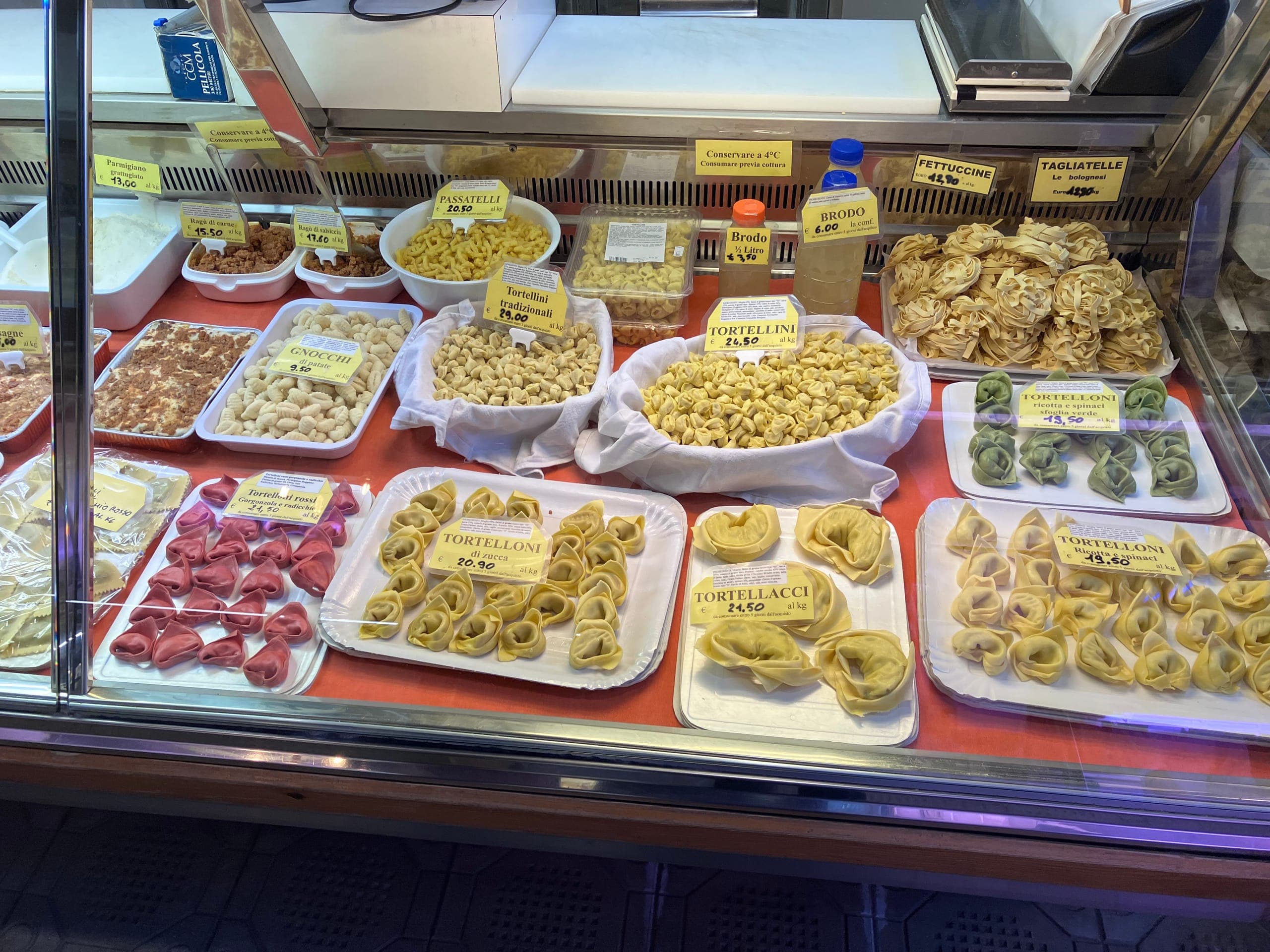
The other half of the case has nothing to do with cars. Modena is a UNESCO World Heritage city with a food culture that is the reason most people come here — balsamic vinegar, Parmigiano Reggiano, tortellini in brodo, and the best cooking served at lunch rather than dinner. A motor trip based here has somewhere to be in the evening. A motor trip based in Maranello does not.
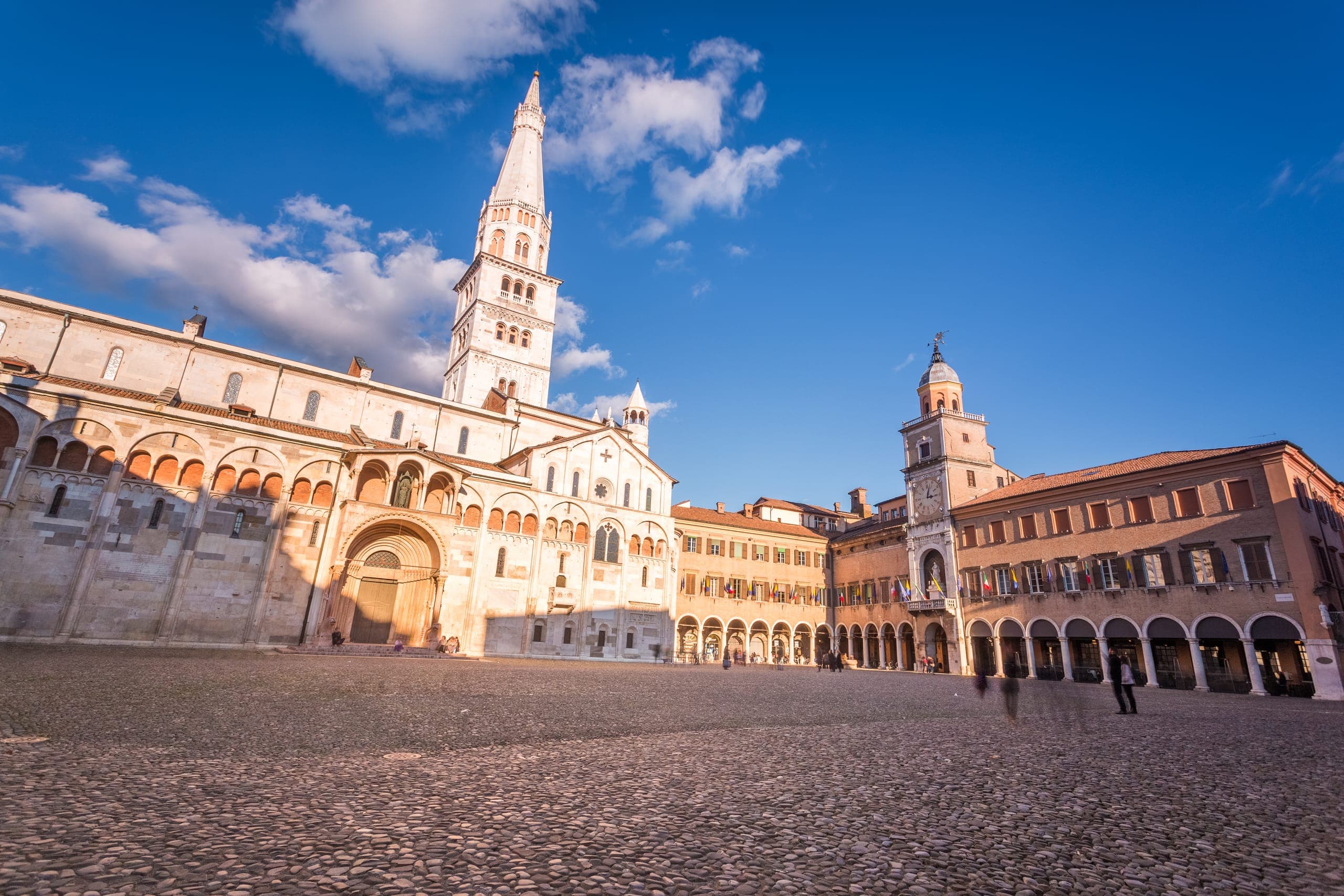
If you want that side of it: where to eat in Modena has the trattorie with hours and prices, what to see in Modena covers the cathedral and the tower, and day trips from Modena widens the circle.
Where to stay
Our four apartments are all in Modena, booked directly with us, with no platform commission.
For a museum trip the difference between them is the car. Two sit on viale Vittorio Veneto, outside the limited traffic zone: no permit to arrange, the car parks in the public bays in front of the door, and the Enzo Ferrari Museum is a walk. Modena Prestige is on the ground floor with six steps at the entrance; the penthouse further along the avenue is on the seventh floor with a lift and a terrace facing the Ghirlandina.
The other two are inside the old walls, on Piazza Mazzini and via De' Correggi — minutes on foot from the coach station the Maranello bus leaves from, which matters if the plan is to do this without a car. For those, if you do drive, we handle the €10-a-day traffic-zone permit.
All four are on our apartments page. We do not run tours or transfers: what we do is tell you which bus, which day, and which museum is shut.
Tickets and tours for the area are collected on our experiences page, with a secure checkout and instant confirmation.
Read before you go
Getting to Modena covers airports, trains and coaches, and matters for one specific reason: arriving on a regional train is worth €7 off a Ferrari museum ticket. Motor Valley from Modena has the bus timetables in detail, and the Ferrari and Lamborghini museums the shuttle between the two Ferrari sites. If you are driving, the Modena ZTL and parking in Modena should be read first — the fines arrive months later.
Frequently asked questions
Which car museums in Italy are closest together? The cluster around Modena. The Enzo Ferrari Museum is in the city itself, the Ferrari Museum at Maranello is 18 km away, Pagani is 17 km, Lamborghini 30 km and Ducati 40 km at Bologna. Maserati runs a tour of its plant inside Modena, and there are two private collections in the city. Everything else in Italy is scattered across separate cities.
Can you visit the Ferrari factory? No. Ferrari's own site restricts plant visits to clients and Formula 1 team sponsors. What is sold as a factory tour is a 45-minute panoramic ride on an electric bus around the site and the Fiorano test track, seated throughout. The factories that genuinely open are Lamborghini, Pagani, Maserati and Ducati.
How many days do you need for the Modena cluster? Two days covers the two Ferrari museums comfortably, using the combined pass that runs on a 48-hour window. Three days adds Lamborghini or Pagani with a factory tour. Four days adds Ducati at Bologna, which sits in a different direction from everything else and deserves its own day.
What is the biggest car museum in Italy? The national automobile museum in Turin, founded in 1933, holds over 200 original cars from 80 marques, from late nineteenth-century steam carriages to prototypes. Adult admission is €18, reduced €15 and €8 for ages 6 to 17. It is open 10:00-14:00 on Mondays and 10:00-19:00 from Tuesday to Sunday.
Do you need a car to visit Italy's car museums? For the Modena cluster, partly. The Enzo Ferrari Museum is a walk from the centre and Maranello has a public bus, but Lamborghini and Pagani have no public connection we would recommend. Turin, Milan, Verona and Brescia museums are all reachable by train and local transport.
Which Italian car museum is best with children? The Ferrari Museum at Maranello, for the reconstructed Formula 1 pit box and the simulators, though the simulator has a minimum height. On price, Ducati is the friendliest of the group with free entry under 11, and Lamborghini charges €6 for students under 19 against €27 or €32 for an adult Ferrari ticket.
When is the cheapest time to visit the Ferrari museums? September to May, when adult admission is €27 rather than €32 and the combined pass €38 rather than €42. High season is June, July and August only, which is narrower than most pages state: May and September cost the same as November. Arriving on an Emilia-Romagna regional train drops one museum to €20 in any season.
Is one base enough, or should you move around? One base works for the Emilia cluster and nothing else. Modena covers five museums and a factory tour within forty kilometres. Turin, Milan, Verona and Brescia are separate trips, each a couple of hours away by train, and pairing them into one itinerary means a lot of railway for a moderate number of cars.
Frequent questions
What readers ask us most.
Which car museums in Italy are closest together?
The cluster around Modena. The Enzo Ferrari Museum is in the city itself, the Ferrari Museum at Maranello is 18 km away, Pagani is 17 km, Lamborghini 30 km and Ducati 40 km at Bologna. Maserati runs a tour of its plant inside Modena, and there are two private collections in the city. Everything else in Italy is scattered across separate cities.
Can you visit the Ferrari factory?
No. Ferrari's own site restricts plant visits to clients and Formula 1 team sponsors. What is sold as a factory tour is a 45-minute panoramic ride on an electric bus around the site and the Fiorano test track, seated throughout. The factories that genuinely open are Lamborghini, Pagani, Maserati and Ducati.
How many days do you need for the Modena cluster?
Two days covers the two Ferrari museums comfortably, using the combined pass that runs on a 48-hour window. Three days adds Lamborghini or Pagani with a factory tour. Four days adds Ducati at Bologna, which sits in a different direction from everything else and deserves its own day.
What is the biggest car museum in Italy?
The national automobile museum in Turin, founded in 1933, holds over 200 original cars from 80 marques, from late nineteenth-century steam carriages to prototypes. Adult admission is €18, reduced €15 and €8 for ages 6 to 17. It is open 10:00-14:00 on Mondays and 10:00-19:00 from Tuesday to Sunday.
Do you need a car to visit Italy's car museums?
For the Modena cluster, partly. The Enzo Ferrari Museum is a walk from the centre and Maranello has a public bus, but Lamborghini and Pagani have no public connection we would recommend. Turin, Milan, Verona and Brescia museums are all reachable by train and local transport.
Which Italian car museum is best with children?
The Ferrari Museum at Maranello, for the reconstructed Formula 1 pit box and the simulators, though the simulator has a minimum height. On price, Ducati is the friendliest of the group with free entry under 11, and Lamborghini charges €6 for students under 19 against €27 or €32 for an adult Ferrari ticket.
When is the cheapest time to visit the Ferrari museums?
September to May, when adult admission is €27 rather than €32 and the combined pass €38 rather than €42. High season is June, July and August only, which is narrower than most pages state: May and September cost the same as November. Arriving on an Emilia-Romagna regional train drops one museum to €20 in any season.
Is one base enough, or should you move around?
One base works for the Emilia cluster and nothing else. Modena covers five museums and a factory tour within forty kilometres. Turin, Milan, Verona and Brescia are separate trips, each a couple of hours away by train, and pairing them into one itinerary means a lot of railway for a moderate number of cars.
The Maranello shuttle leaves from here.
From Modena the Ferrari museums are a shuttle ride away — no car needed — and in the evening you are back in the centre. Our apartments are a short walk from where it departs.