Festivalfilosofia 2026: The Modena Philosophy Festival Without Italian
FNFrancesco NoliThe short answer
Festivalfilosofia runs from Friday 18 to Sunday 20 September 2026 across Modena, Carpi and Sassuolo, on the theme of chaos. Everything is free and nothing is booked: you turn up, and entry stops when the square is full. The lectures are in Italian — the official programme marks only three as foreign-language, by David Armitage, Luke Kemp and Pierre Charbonnier, each with Italian voice-over. What carries no language barrier is everything around them: twenty-eight free exhibitions open late into the evening, thirteen music events, films shown in the original with Italian subtitles, and three cities running on philosophy for seventy-two hours.
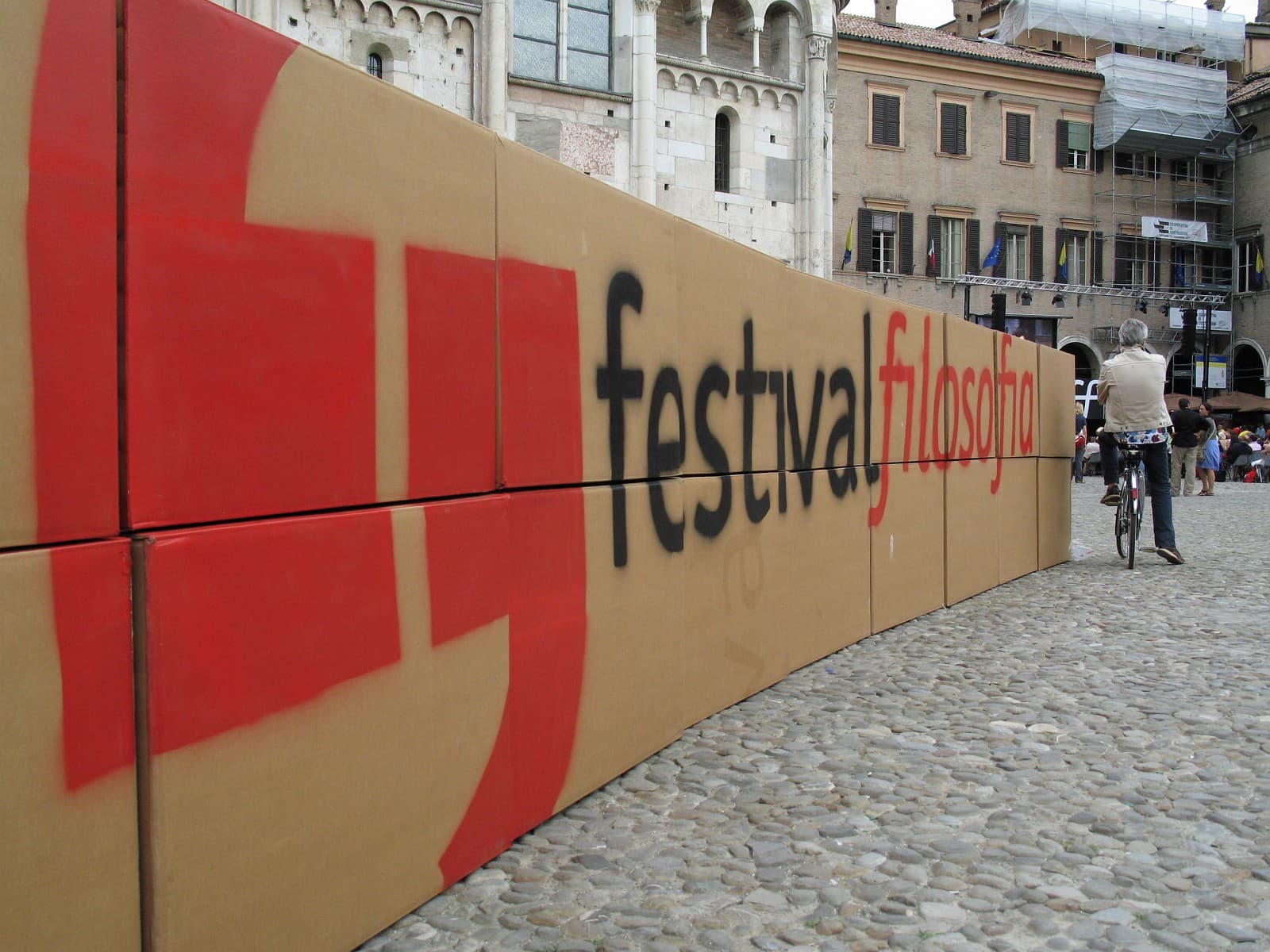
The lectures are in Italian and only three are not. What a foreign visitor can actually do at Modena's philosophy festival, and how the three days work.
Every September, Modena hands its main square over to philosophy for three days, and in its record year the three days counted more than 206,000 attendances. If you are reading this from abroad, the question you actually need answered is not what the theme is. It is whether a festival of lectures delivered in Italian is worth crossing a border for.
The honest answer has two halves, and the first is discouraging: the lectures are in Italian, and the festival's own website has no English version. The second half is why this page exists. The lectures are about a third of what happens; the rest of the programme has no language in it at all. Everything below was checked against the official programme and the festival's own information pages on 22 August 2026.
First, the part nobody tells you
The 2026 programme lists 51 lezioni magistrali — the main lectures — plus six "lessons of the classics" and one debate. The official rules page says, in a single line: tutte le lezioni in lingua straniera prevedono la traduzione simultanea in oversound. All foreign-language lectures come with simultaneous voice-over translation.
That runs in the direction you do not want. The translation brings foreign speakers into Italian, for an Italian audience. There is no relay the other way.
Which leaves the useful question: how many lectures are not in Italian to begin with? We went through the programme event by event. Exactly three carry the Oversound marking.
| Speaker | Lecture | When | Where |
|---|---|---|---|
| David Armitage | Civil wars: a paradigm for the contemporary age | Fri 18, 3pm | Modena, Piazza Grande |
| Pierre Charbonnier | A planet in chaos: the ecological consequences of war | Fri 18, 4.30pm | Carpi, Piazza Martiri |
| Luke Kemp | Collapse: how societies fall or hold | Sun 20, 3pm | Carpi, Piazza Martiri |
Armitage holds the Blankfein chair in history at Harvard; Kemp is a research associate at Cambridge's Centre for the Study of Existential Risk; Charbonnier is a CNRS researcher based at Sciences Po. Two of the three work in English — but the programme marks the translation, not the delivery language, so treat English as likely rather than promised. The corollary is firmer: the other two foreign names on the bill, Anne Cheng of the Collège de France and Francisco Jarauta, are each marked In italiano. They will speak Italian.
How the voice-over actually works, and what we cannot tell you
Oversound is voice-over interpreting: the Italian translation plays over the speaker's original audio, which stays audible underneath. In an open square, on a public address system, the Italian is what carries.
We could not confirm whether headphones with a clean original feed exist, and the festival's information pages do not address it. If hearing Armitage or Kemp in the original is what would make the trip worthwhile, write to info@festivalfilosofia.it before you travel. We would rather say that than guess.
What has no language barrier at all
This is the half of the festival visitors from abroad underestimate, and it is large. All of it is free.
Twenty-eight exhibitions, spread across the three cities and open all three days, most of them until late in the evening. Not one of them needs a word of Italian to be worth an hour.
| Exhibition | Where | Hours: Fri / Sat / Sun |
|---|---|---|
| Le acque del caos e l'ordine di Maat — a Museo Egizio show on Egyptian cosmogony | Carpi, Palazzo dei Pio | 10am-11pm / 10am-11pm / 10am-8pm |
| Julian Schnabel – Pietro Moretti, Neo-espressionismi | Sassuolo, Paggeria Arte | 9am-10pm / 9am-10pm / 9am-8pm |
| Χάος CAOS. Spaces and poetics of the Informale | Modena, La Galleria BPER | 9am-11pm / 9am-11pm / 9am-9pm |
| Chaos = Flux — Gabriele Basilico and Giovanni Hänninen | Modena, Galleria Antonio Verolino | 9am-11pm / 9am-11pm / 9am-9pm |
| Pinocchio a rotta di collo — metamorphoses of a puppet | Modena, Palazzo Santa Margherita | 9am-11pm / 9am-11pm / 9am-9pm |
| Mappa Mutantis Mundi — Karin Andersen | Modena, Musei del Duomo | 10am-6pm / 10am-7pm / 10am-7pm |
| Nutrire l'utopia — counterculture and autonomous spaces | Modena, Palazzo dei Musei | 9am-11pm / 9am-11pm / 9am-9pm |
| Il regno della quantità e i segni dei tempi | Modena, Metronom | 11am-9pm / 11am-8pm / 11am-7pm |
Museums open free until eleven at night on the Friday and the Saturday is not a normal weekend anywhere, and it is the single best reason for a non-Italian speaker to pick this one over any other in September. Read the hours off the table, though: they are not uniform, and Sunday closes earlier everywhere.
Thirteen music events. The one to know is Babylon 26 at the Giardini Ducali in Modena, in two acts: Ninos du Brasil, live show and dj set, Friday 9.30pm to midnight, and KINKI – The Secrets of the Dancefloor, Saturday 9pm to midnight. Both outdoors in the ducal gardens, both free, and neither asks you to understand anything.
Films in the original. Eleven screenings, five of them shown in the original version with Italian subtitles — for an English speaker, the ideal arrangement. Two are American: The lunch – a letter to America (Sunday 20, 6.30pm) and The encampments (Sunday 20, 8.30pm), both at the Sala Truffaut in Modena.
The city itself. Squares full of people sitting on the ground to listen to a philosopher, book stalls open in Piazza Grande until eleven, radio and television broadcasting live from the streets. You do not need the words to see that something is happening.
What works and what does not, by type of event
The blunt version, the one we send guests who ask.
| What | Language needed | Verdict for a foreign visitor |
|---|---|---|
| The 51 main lectures | Italian, fluent | Skip, unless you read Italian well |
| The three foreign-language lectures | English or French, with Italian over it | Worth trying; audio is not guaranteed |
| Twenty-eight exhibitions | None | The main reason to come |
| Music at the Giardini Ducali | None | Free, outdoors, late |
| Films in the original | English for two of them | Better than a normal cinema trip |
| Theatre and readings | Italian | Skip — these are text-heavy |
| Children's workshops | Italian | Skip unless your children speak it |
| Book stalls and the squares at night | None | Free, and the best of the atmosphere |
Dates, structure, and why the geography matters
Friday 18 to Sunday 20 September 2026, the third weekend of September, on the theme of caos — chaos as a generating principle rather than mess. It is the 26th edition. Lectures start at 10am on the Friday; on the Friday and Saturday the last talks and readings begin at 10pm, and the music in the Giardini Ducali runs to midnight.
What catches people out is that this is not one festival in one city. Modena, Carpi and Sassuolo run in parallel, not in sequence. Each has its own fixed stages:
- Modena — Piazza Grande, the UNESCO World Heritage site in front of the cathedral, plus Piazza Sant'Agostino, the tent in Piazza XX settembre, the church of San Carlo, Palazzo dei Musei, Palazzo Santa Margherita and the Giardini Ducali.
- Carpi — Piazza dei Martiri and the tent in Piazzale Re Astolfo, about 18 km north.
- Sassuolo — Piazza Garibaldi and the Teatro Carani, about 17 km south-west.
Lectures fall in fixed slots — 10am, 11.30am, 3pm, 4.30pm, 6pm, 8.30pm — and the three cities run them at the same time. At 3pm on the Friday, Armitage is in Piazza Grande in Modena while Mariarosaria Taddeo is talking about the ethics of artificial intelligence applied to security, in Carpi. You cannot see both. Anyone who tells you they saw the whole festival did not.
One footnote on the numbers elsewhere: some press reports say "almost 200 events", the consortium's own release says "over 150". The difference is whether a three-day exhibition counts once or three times. Same programme.
Free, no booking — and what that means when you get there
The official page is unambiguous: tutte le iniziative del festivalfilosofia sono gratuite — everything is free, exhibitions included. And for the lectures and shows in the main squares, non è necessaria alcuna prenotazione.
There is no ticket, no registration, no queue system. What there is instead:
- Access is suspended once the safety limit is reached. For a name like Cacciari in Piazza Grande on the Friday evening, the square fills. Arriving early is the only strategy, and the bigger the name the earlier.
- Every venue is accessible to disabled visitors, with dedicated seating.
- The morning and afternoon lectures are relayed on large screens at other venues — in Modena the circuit is Piazza Grande, Piazza XX settembre, the church of San Carlo and Piazza Sant'Agostino; in Carpi, Piazza Martiri and Piazzale Re Astolfo; in Sassuolo, Piazza Garibaldi and the Teatro Carani. If you cannot get into the square, you can still watch.
- In bad weather, lectures move into the tents: Piazza XX settembre, the Arena Spazio Culturale and La Tenda in Modena, Piazzale Re Astolfo in Carpi, the Teatro Carani in Sassuolo. The screen relay runs regardless.
- The official page warns that a few individual events may require a reservation, indicated on their own programme page. We found no active booking link on any 2026 event, and nothing in the squares works that way.
- On the Friday morning only, part of the seating is held for school groups who asked for it. That channel is not open to the public.
The website's "il mio programma" feature builds a personal agenda. It is a planner, not a reservation: it does not hold a seat.
Getting here, and moving between the three cities
Modena has no airport. You fly into Bologna Marconi, 50 km away; our guide to getting to Modena sets out the shuttle-versus-monorail arithmetic. During the festival one thing matters more than the rest: the trains back.
Direct trains run all day and the journey is under half an hour. On the timetable we consulted there were still departures from Modena after 11pm — but we could not confirm those late times against a primary source, and the last services of the night are long-distance trains needing their own ticket rather than a regional fare. Look up your return on trenitalia.com and buy it before the lecture, not after.
Between the three cities there is no shuttle. The festival has instead agreed fixed taxi fares with Co.Ta.Mo, published on its taxi convention page:
| Route | Fixed fare |
|---|---|
| Modena centre or station to Carpi | €40 |
| Modena centre or station to Sassuolo | €40 |
| Sassuolo back to Modena | €50 |
| Carpi to Modena centre or station | €35 |
| Within Modena's walls, station to centre | €7 weekday, €8 Sunday, €9 after 9.30pm |
| Modena to Bologna Marconi airport | €75 (€85 inbound) |
These are maximum chargeable fares, not flat prices. Luggage is €0.50 a piece, five or six passengers adds 20%, and the €35 Carpi-to-Modena fare carries a 30% surcharge if the car sets out from Modena. Radio Taxi is 059 374242 for Modena, 059 353888 for Carpi. The page carries no revision date, so confirm the fare with the driver.
Carpi is on the Modena-Carpi-Mantova line. Sassuolo is on a local line that leaves from Modena Piazza Manzoni, not the main station — an easy mistake with a 3pm lecture to catch. Sunday services on both local lines thin out sharply: check trenitaliatper.it first. Buses serve both towns too.
Our own advice: pick one city a day. Chasing two names in two cities costs an hour and a half of moving. Modena has the largest programme, the late museums and the music; if you have three days, give one to Carpi, which is small, walkable, and where several of the strongest lectures land.
Doing it as a day trip from Bologna
It works, and a lot of people do it. Take a morning train, spend the day in Modena, take one of the late evening departures back — that leaves the 7.30pm Cacciari and Esposito debate in Piazza Grande on the Friday, and the 10pm reading afterwards.
What you give up is the end of the night: the Giardini Ducali music runs to midnight both nights, and no train makes that work. If the late programme is what you want, sleep here. Our Modena day trip guide has the general timings; during the festival everything shifts later.
Eating, when the lecture slots eat the meal times
Look at those fixed slots again — 3pm, 4.30pm, 6pm — and the problem is obvious: they fall straight across Italian lunch and dinner. Anyone following the programme eats between 1pm and 2.30pm, and again after 9.30pm.
The festival's answer is the razionsufficiente: a takeaway ration of local food, never priced above €10, contents left to each shop. In Modena it is at eleven stalls inside the Albinelli covered market, a minute from Piazza Grande, open Friday 7am-3pm, Saturday 7am-7pm, Sunday 8am-3pm. In Carpi it is at the Circolo Mattatoyo by Piazzale Re Astolfo, 11.30am-3pm and 6.30-9.30pm all three days (official page).
The other tradition is the philosophical menus: themed set menus served across the three cities, an idea running since the first edition in 2001. Two caveats. Prices are set by each restaurant and are not published centrally. And the festival's own page still carried the text of an earlier edition when we checked on 22 August 2026 — read it for the idea, not for this year's dishes.
Otherwise our guide to where to eat in Modena applies, with one correction for this weekend: every trattoria in the centre fills. Book, or eat at the market.
Where the beds go, and how fast
This is the weekend the city runs out. The consortium's own published figures go from 34,000 attendances at the first edition in 2001 to more than 206,000 in 2019, its record year, across 942 lectures in twenty-one editions and a direct economic impact valued at over €3 million.
Set that against the supply: the hotels in the festival's own taxi convention come to five in Carpi, three in Sassuolo and a few dozen in Modena, most of them small. That is a provincial city's bed stock absorbing a national event. The festival does not handle accommodation — it points to visitmodena.it and stops.
The consequence is simple: book weeks ahead, not days. People who leave it late commute in from Bologna or Reggio Emilia, which turns three days of festival into three days of trains.
Who should not come for this
The part that the event listings never write.
- If your only interest is hearing the philosophers, and you do not read Italian. Fifty-one lectures, three of them in another language, no English relay. That is the whole picture.
- If you want a quiet weekend in a small art city. This is the opposite. Squares full, museums busy, restaurants non-stop: the city you would see on a normal September Saturday is not visible.
- If you are travelling with small children and no Italian. The children's programme is substantial — dozens of workshops — and entirely in Italian. The exhibitions and the gardens work; the workshops will not.
- If you need a plan that holds. Three cities in parallel, no reservations, entry closing when a square fills, rain moving everything into a tent. It rewards people who improvise.
- If you were hoping to add the Ferrari museums the same weekend. You can, but you will do both badly: our motor museums guide is a full day.
- If you are driving. The historic centre is a camera-enforced restricted zone, live around the clock, and the city publishes its festival traffic orders only in early September. Our guide to getting to Modena explains the cameras and the car parks; check the current traffic orders before you set off.
Where to stay
Almost everything worth your time over those three days is inside the walls — Piazza Grande, Piazza Sant'Agostino, Palazzo dei Musei, Palazzo Santa Margherita, the Albinelli market, the Giardini Ducali — all within a fifteen-minute walk of each other. Staying inside that circle lets you dip in and out all day instead of committing to one square for the afternoon.
Our four apartments are all in the centre, and you book directly with us, with no platform commission. On this weekend the earlier you write, the more choice there is.
If you are driving, the four are not the same. Piazza Mazzini and via De' Correggi sit inside the restricted zone, and for those two we arrange the entry pass ourselves at €10 a day, which also makes parking inside the zone free. Viale Vittorio Veneto 119 and 67 are outside the zone, so no permit is needed and the car goes under the building — worth more than it sounds on a weekend when every space in the centre is taken.
We run no tours, and for this festival there is no ticket to sell: it is free and unbookable. What we send you before you arrive is the schedule of what is on where, which squares fill first, and where to leave the car. If you want a restaurant table on the Saturday night, tell us early and we will call.
See our apartments in Modena, or where to stay in Modena if you are still choosing an area.
If your festival is the one happening in Modena's squares, the penthouse on Piazza Mazzini is two minutes' walk from Piazza Grande and sleeps up to eight.
Read before you go
What to see in Modena and Modena in a day cover the city that is there the rest of the year; the cathedral guide explains the building the lectures sit in front of. A balsamic vinegar producer visit fills the morning before the 3pm slot. If you are still deciding, is Modena worth visiting answers that without the brochure voice, and day trips from Modena covers what else is within an hour.
The full programme, with every event, time and venue, is on the festival's own site at festivalfilosofia.it. It is in Italian only, but times, places and names are legible in any language, and it is the only source that is always current.
Frequently asked questions
Is the festivalfilosofia worth visiting if I do not speak Italian? It depends what you come for. If you come to follow the lectures, no — almost all are in Italian and there is no English relay. If you come for the exhibitions, the concerts, the films and three cities given over to one subject for three days, yes, and it costs nothing. Twenty-eight free exhibitions and thirteen music events need no Italian at all.
Are any lectures given in English? The 2026 programme marks exactly three lectures as foreign-language, each with Italian voice-over interpreting: David Armitage (Friday 18, 3pm, Piazza Grande, Modena), Pierre Charbonnier (Friday 18, 4.30pm, Piazza Martiri, Carpi) and Luke Kemp (Sunday 20, 3pm, Piazza Martiri, Carpi). Armitage teaches at Harvard, Kemp at Cambridge; Charbonnier is French. The programme marks the translation rather than the delivery language, so confirm with the organisers if it decides your trip.
Do I need tickets or a booking? No. The official wording is that all festival initiatives are free and that no booking is required for the lectures and shows in the main squares — access is simply suspended once the safety limit is reached. There is no ticket and no queue to join in advance. A few individual events note a reservation on their own programme page, and school groups can book Friday-morning seats, but nothing in the squares works that way.
When is the festivalfilosofia in 2026, and where? Friday 18 to Sunday 20 September 2026, the third weekend of September, across three cities at once: Modena, Carpi and Sassuolo. The theme of the 26th edition is chaos. Lectures start on the Friday at 10am; on the Friday and Saturday the last talks and readings begin at 10pm and the music in the Giardini Ducali runs to midnight, and the last event on the Sunday is in the early evening.
Can I do the philosophy festival as a day trip from Bologna? Yes, easily. Direct trains run all day and take under half an hour, and on the timetable we consulted there were still departures from Modena after 11pm — late enough to stay for the 10pm reading in Piazza Grande. Check your own return on trenitalia.com, because we could not confirm those evening times against a primary source. What you lose is the late-night part at the Giardini Ducali, which runs to midnight.
How far in advance should I book accommodation in Modena? As early as you can. This is the busiest weekend of the year for the city: the festival's own figures go from 34,000 attendances in 2001 to more than 206,000 in 2019. It does not handle accommodation itself and points visitors to visitmodena.it. Central rooms and apartments go weeks ahead, and people who leave it late end up in Bologna or Reggio Emilia.
How do I get between Modena, Carpi and Sassuolo during the festival? There is no festival shuttle. Carpi is on the Modena-Mantova line; Sassuolo is on a local line leaving from Modena Piazza Manzoni, not the main station. Both are also reachable by bus or car. The festival has agreed fixed taxi fares with Co.Ta.Mo: €40 from Modena centre or station to Carpi, €40 to Sassuolo, €50 back from Sassuolo, €35 from Carpi to Modena. Radio Taxi Modena is 059 374242.
What does it cost to eat during the festival? The cultural programme is free; food is not. The razionsufficiente is a takeaway ration priced at never more than €10, sold at eleven stalls inside the Albinelli covered market in Modena, open 7am-3pm Friday, 7am-7pm Saturday and 8am-3pm Sunday. Restaurants across the three cities also serve themed philosophical menus, at prices each sets itself and does not publish centrally.
Frequent questions
What readers ask us most.
Is the festivalfilosofia worth visiting if I do not speak Italian?
It depends what you come for. If you come to follow the lectures, no — almost all are in Italian and there is no English relay. If you come for the exhibitions, the concerts, the films and three cities given over to one subject for three days, yes, and it costs nothing. Twenty-eight free exhibitions and thirteen music events need no Italian at all.
Are any lectures given in English?
The 2026 programme marks exactly three lectures as foreign-language, each with Italian voice-over interpreting: David Armitage (Friday 18, 3pm, Piazza Grande, Modena), Pierre Charbonnier (Friday 18, 4.30pm, Piazza Martiri, Carpi) and Luke Kemp (Sunday 20, 3pm, Piazza Martiri, Carpi). Armitage teaches at Harvard, Kemp at Cambridge; Charbonnier is French. The programme marks the translation rather than the delivery language, so confirm with the organisers if it decides your trip.
Do I need tickets or a booking?
No. The official wording is that all festival initiatives are free and that no booking is required for the lectures and shows in the main squares — access is simply suspended once the safety limit is reached. There is no ticket and no queue to join in advance. A few individual events note a reservation on their own programme page, and school groups can book Friday-morning seats, but nothing in the squares works that way.
When is the festivalfilosofia in 2026, and where?
Friday 18 to Sunday 20 September 2026, the third weekend of September, across three cities at once: Modena, Carpi and Sassuolo. The theme of the 26th edition is chaos. Lectures start on the Friday at 10am; on the Friday and Saturday the last talks and readings begin at 10pm and the music in the Giardini Ducali runs to midnight, and the last event on the Sunday is in the early evening.
Can I do the philosophy festival as a day trip from Bologna?
Yes, easily. Direct trains run all day and take under half an hour, and on the timetable we consulted there were still departures from Modena after 11pm — late enough to stay for the 10pm reading in Piazza Grande. Check your own return on trenitalia.com, because we could not confirm those evening times against a primary source. What you lose is the late-night part at the Giardini Ducali, which runs to midnight.
How far in advance should I book accommodation in Modena?
As early as you can. This is the busiest weekend of the year for the city: the festival's own figures go from 34,000 attendances in 2001 to more than 206,000 in 2019. It does not handle accommodation itself and points visitors to visitmodena.it. Central rooms and apartments go weeks ahead, and people who leave it late end up in Bologna or Reggio Emilia.
How do I get between Modena, Carpi and Sassuolo during the festival?
There is no festival shuttle. Carpi is on the Modena-Mantova line; Sassuolo is on a local line leaving from Modena Piazza Manzoni, not the main station. Both are also reachable by bus or car. The festival has agreed fixed taxi fares with Co.Ta.Mo: €40 from Modena centre or station to Carpi, €40 to Sassuolo, €50 back from Sassuolo, €35 from Carpi to Modena. Radio Taxi Modena is 059 374242.
What does it cost to eat during the festival?
The cultural programme is free; food is not. The razionsufficiente is a takeaway ration priced at never more than €10, sold at eleven stalls inside the Albinelli covered market in Modena, open 7am-3pm Friday, 7am-7pm Saturday and 8am-3pm Sunday. Restaurants across the three cities also serve themed philosophical menus, at prices each sets itself and does not publish centrally.
Stay in the centre, see Modena on foot.
All our apartments are inside the historic centre: step out of the door and you are already in the middle of what you have just read about. No restricted-traffic zone to decode, no parking to hunt for every morning.